The Robotics Revolution Isn’t What Most People Think It Is
Humanoid robots dominate headlines, but the real robotics revolution is already here — in warehouses, factories and hospitals. Here’s what most people miss.

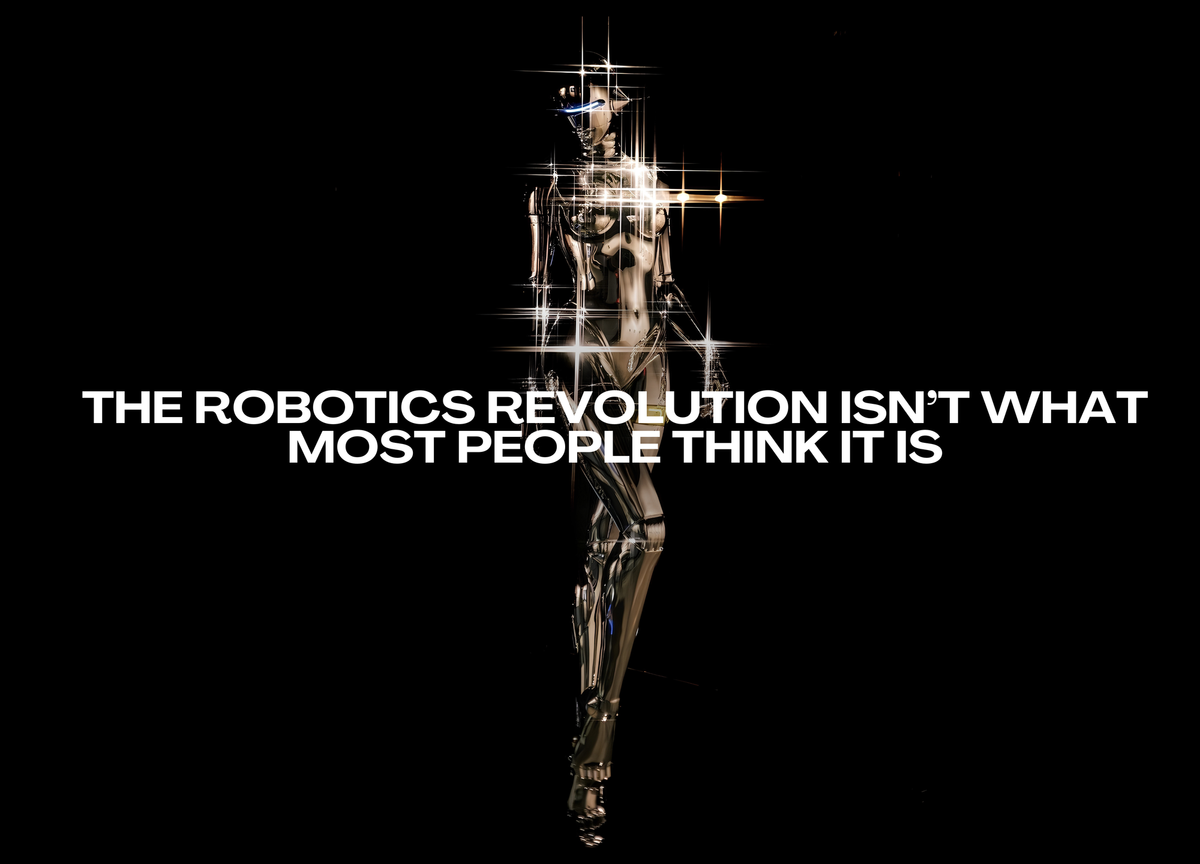
While public attention remains fixed on humanoid robots, the real transformation is already unfolding inside warehouses, hospitals, farms and factories. Understanding that shift means understanding where the future of work, industry and the global economy is actually heading.
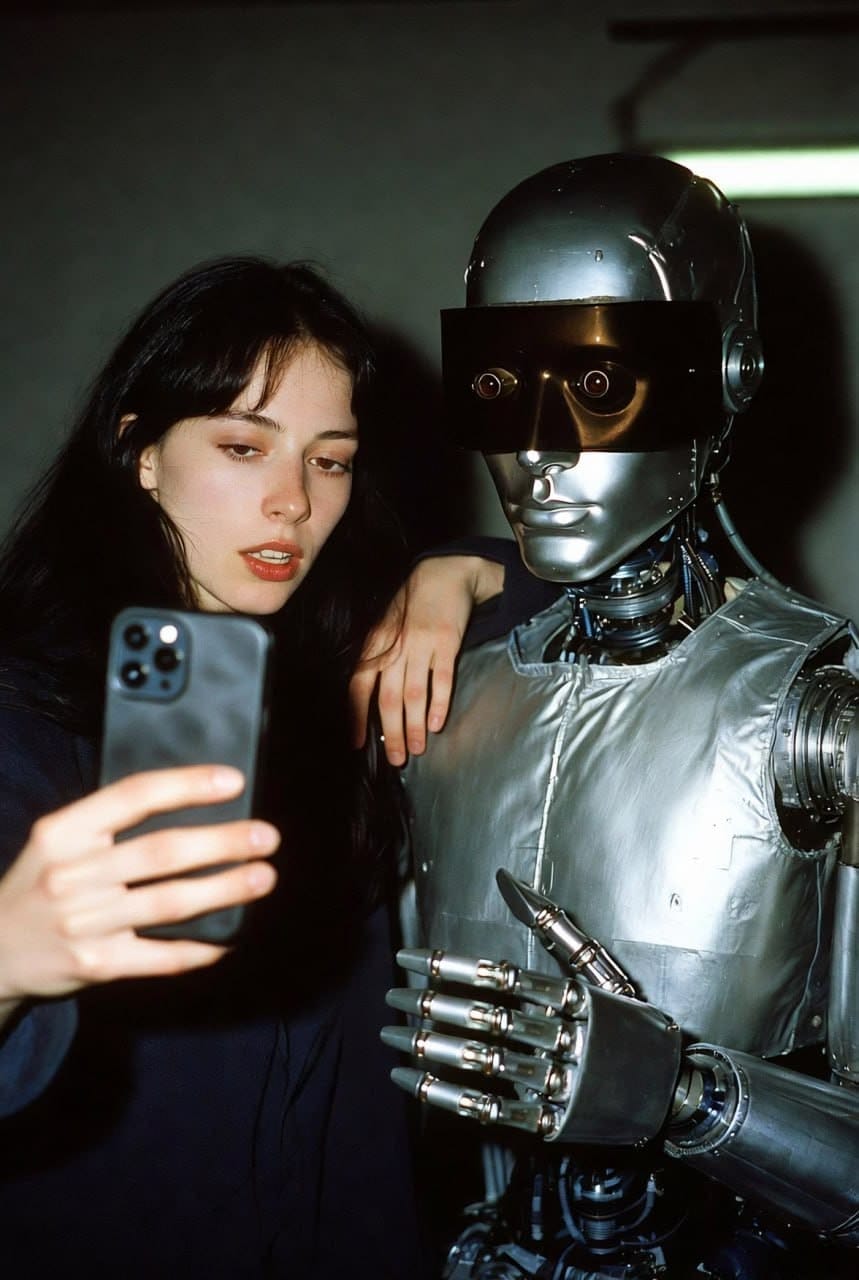
Ask someone to picture a robot, and they will almost certainly picture a body. Two arms, two legs, a head that turns to meet your gaze. It is a reasonable thing to imagine. It is also, in 2026, almost entirely the wrong picture.
The robots actually reshaping the global economy right now rarely look like anything at all. They look like a steel arm bolted to a factory floor. A knee-high disc gliding beneath a shelving unit. A camera and a set of grippers mounted above a conveyor belt, sorting a thousand parcels an hour without ever standing up. None of this fits the image most people carry around in their heads, and that mismatch is not a minor detail. It is the reason so many otherwise well-informed people believe the robotics revolution is still years away, when in fact it has already arrived and quietly rearranged how much of the world works.
This is not an article about robots becoming more human. It is an article about why we assumed that was the point in the first place — and what we have been missing while we waited for it to happen.
The picture in our heads
The belief is not unreasonable. It has been built, carefully and repeatedly, over the better part of a century. Science fiction gave us robots with faces because stories need characters, not conveyor systems. Star Wars gave us C-3PO. Terminator gave us a machine built explicitly to pass as one of us. Even the optimistic depictions — a helpful android doing the washing up — reinforced the same assumption: that the destination of robotics is a mechanical version of ourselves.
Psychology does the rest of the work. Humans are extraordinarily good at anthropomorphising, at reading intention and personality into anything that moves with apparent purpose. A robot with a face is instantly legible in a way a warehouse arm is not; we know how to feel about it, what to expect from it, whether to be charmed or unsettled. A humanoid also makes for better television. When Boston Dynamics releases a video of Atlas performing a backflip, or Tesla wheels Optimus onto a stage, the footage travels around the world within hours, because it plays on the oldest storytelling instinct there is. When a Kawasaki arm performs eleven thousand precise welds a day inside a Nagoya car plant, nobody films it, because there is no protagonist to watch.
None of this makes the fascination wrong, exactly. It makes it disproportionate. Humanoid robots currently represent a tiny fraction of the robots doing paid, productive work in the world today, and a wildly outsized fraction of the coverage devoted to robotics. That gap between attention and reality is where the misunderstanding lives.
Where the revolution actually is
Strip away the theatre and look at where money, deployment and measurable output are concentrated, and a very different map appears — one made up of machines that were never designed to look like us because looking like us was never the job.
Industrial robots are the least glamorous and most consequential category. According to the International Federation of Robotics, 542,000 industrial robots were installed worldwide in 2024, more than double the figure from a decade earlier, and the fourth consecutive year that annual installations topped half a million units. The global operational stock — robots currently working, not merely sold — reached roughly 4.66 million, a rise of 9% on the year before. These are the arms welding car bodies, moving semiconductor wafers, packing goods and assembling electronics across factories from Shenzhen to Stuttgart. Asia now accounts for close to three-quarters of new deployments, with China alone responsible for the majority of global installations.
Then there is the logistics layer, which has scaled with startling speed. Amazon passed a symbolic threshold in mid-2025: its one-millionth robot, delivered to a fulfilment centre in Japan. That fleet is not one machine repeated a million times but an entire ecosystem — Proteus units that navigate warehouse floors alongside people, Sparrow arms that pick individual items from totes, and Vulcan, a newer system that can sense the force it applies and adjust its grip accordingly. Roughly three-quarters of Amazon’s global deliveries are now assisted, in some way, by a robot that most customers never think about, because it never leaves the building.
Agriculture, construction, mining and energy have quietly absorbed similar volumes of automation — autonomous tractors that steer themselves through fields by satellite, driverless haul trucks moving ore across mine sites, inspection robots that climb pipelines and wind turbines to look for faults humans would rather not check by hand. Healthcare has its own trajectory: the IFR recorded a 91% jump in sales of medical robots in 2024 alone, driven substantially by the continued spread of surgical systems that let surgeons operate with a precision and stability no human hand can quite match unaided.
And then there is the category people rarely think to call robotics at all: the self-driving car. An autonomous vehicle is, definitionally, a mobile robot — one that perceives its environment, plans a path through it and acts, entirely without the humanoid form that supposedly defines the category. It is one of the most capital-intensive robotics programmes on the planet, and almost nobody discusses it in those terms.
Add all of this together and a genuinely uncomfortable truth emerges for anyone still waiting for humanoids to signal that the future has arrived: specialised, purpose-built robots already generate vastly more economic value today than humanoid robots do, and will continue to for some time yet. The humanoid is not further along a shared path than the warehouse arm. It is solving a different, and currently much harder, problem.
Why this actually matters
This is not a distinction that only matters to engineers. Manufacturers across the developed world are contending with acute labour shortages, particularly in roles nobody especially wants — repetitive, physically taxing, or simply unfilled because populations are ageing faster than they are being replaced. Automation of this specialised kind is one of the few available levers that can lift productivity without requiring a larger workforce, which is precisely why McKinsey and other research groups have identified robotics-driven automation as a meaningful contributor to future GDP growth, particularly in economies facing demographic headwinds.
Supply chains, too, have been rebuilt around this quieter form of robotics. The pressure to shorten delivery windows, reduce error rates and absorb demand spikes without proportionally expanding headcount has made warehouse automation less a competitive advantage than a baseline expectation. The companies without it are, increasingly, the companies operating at a structural disadvantage.
None of this shows up as an obvious historical moment. There is no single day on which industrial robotics “arrived,” the way there might be a headline event for a new humanoid launch. It has arrived cumulatively, plant by plant and warehouse by warehouse, which is exactly why it has been so easy to miss.
The bigger shift underneath it
What connects all of this — the arms, the mobile robots, the surgical systems, even the humanoids eventually — is a change happening one layer beneath the hardware. For the past several years, the defining story in artificial intelligence has been language: models that could read, write and reason about the world in text. The next chapter, and the one now consuming enormous amounts of investment, is teaching that same intelligence to operate in physical space.
Nvidia has built much of its current strategy around this idea, which it calls physical AI — systems that understand not just information, but the physical laws governing the objects around them. Jensen Huang has described it repeatedly as the next frontier for the company, and at its 2026 developer conference Nvidia framed physical AI, alongside agentic software, as the defining theme shaping the year’s roadmap. Google DeepMind has pursued a parallel path with its Gemini Robotics family, a series of models — the latest capable of controlling full humanoid bodies as well as simpler two-armed platforms — that extend a general-purpose AI model into direct control of physical actions, rather than building bespoke software for every individual machine.
This is the part of the story that actually deserves the word transformation. The old approach to robotics required an engineer to hand-code behaviour for every task, every environment, every edge case. The new approach trains a foundation model in simulation, on vast quantities of demonstration data, then adapts it to new bodies and new tasks with remarkably little additional input — in some cases just a few hundred examples. Software, not hardware, is becoming the constraint that determines how capable a robot can be. Which means the companies best positioned to win the coming decade of robotics may not be the ones building the most elegant limbs, but the ones building the most capable minds to put inside them.
In defence of the humanoid
None of this is an argument against humanoid robots, and it would be a mistake to read it that way. They exist because they are solving a real and specific engineering problem: the built world was designed around the human body, not around wheels or tracks or fixed arms. Stairs, doors, tools, vehicle cabs, factory workstations — all of it assumes a particular shape and reach. A humanoid is, in effect, a compatibility layer, a way of deploying general-purpose labour into infrastructure that will not be redesigned around a robot any time soon.
Goldman Sachs Research now estimates the total addressable market for humanoid robots could reach $38bn by 2035, a figure it revised sharply upward from an earlier $6bn projection as AI progress outpaced expectations. That is a genuinely significant number. It is also a fraction of what specialised industrial and service robotics already represent today. Humanoids are a compelling and important part of the robotics story. They are not the whole of it, and treating them as a proxy for the entire field has quietly obscured almost everything else that has already happened.
Seeing the present more clearly
Electricity did not announce its arrival with a single decisive moment either. It disappeared into the walls of buildings, and within a generation nobody thought of a lit room as remarkable. The internet followed the same path, vanishing from view as it became a substrate running underneath ordinary life rather than a novelty sitting on top of it. Artificial intelligence is, right now, in the early stages of doing the same thing — sliding out of the browser tab and into the software running everything else.
Robotics will follow that pattern too, and in large part it already has. It will not announce itself with a humanoid standing in every home, however striking that image remains. It will keep disappearing into infrastructure — into the arm that welds the car, the robot that clears the warehouse aisle, the system that guides the surgeon’s hand — until the question of whether the robotics revolution has happened stops making sense, because there will be nothing left standing outside it to compare it to.
By the time most people conclude that the robotics revolution has arrived, it already will have — for years. Understanding that shift isn’t really about predicting the future. It’s about seeing the present more clearly.