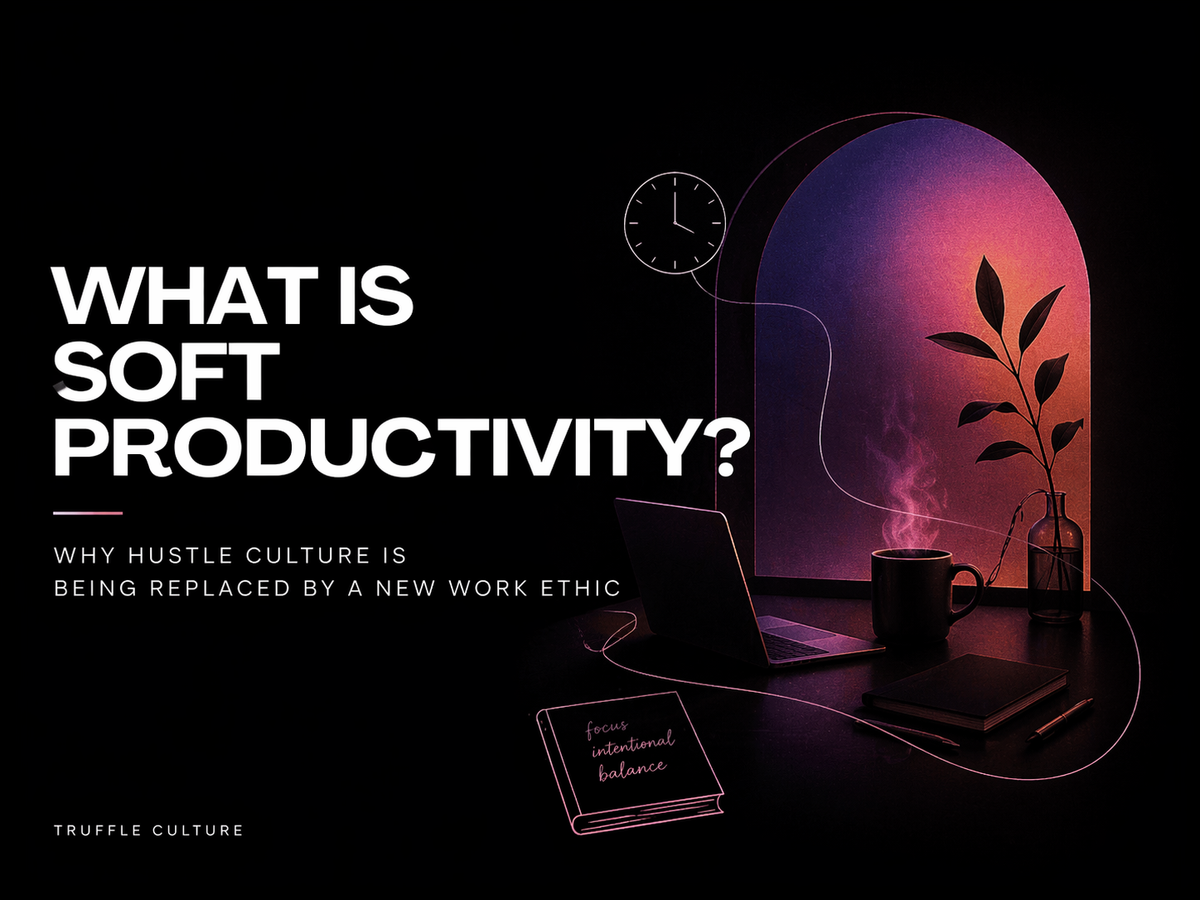
What Is Soft Productivity? Why Hustle Culture Is Being Replaced by a New Work Ethic
Soft productivity is replacing hustle culture as the dominant work ethic, shifting focus from constant output to intentional, high-quality work driven by attention, balance, and control.

For years, productivity has been performed as spectacle. It has lived in the language of full calendars, early mornings, late nights, and the quiet pride of exhaustion. To be busy was to be important. To be overwhelmed was to signal demand. Hustle culture did not simply reward output. It aestheticised it.
Now, something more subtle is taking hold. The performance has not disappeared, but it has changed form. Across social media, workplace structures, and generational attitudes, a new mode of working is emerging. It looks slower, calmer, and more controlled. It prioritises focus over volume, intention over intensity, and boundaries over availability. It is being called “soft productivity.”
At first glance, it reads like a retreat. A softening of ambition. A cultural exhale after a decade of overextension. But beneath the surface, it is something more consequential. Soft productivity is not the opposite of hustle culture. It is its evolution. A redefinition of what productive behaviour looks like in a world where attention, not time, has become the scarcest resource.
What Is Soft Productivity?
Soft productivity refers to a way of working that emphasises focused output, reduced cognitive overload, and intentional effort, rather than constant activity. It rejects the idea that productivity is measured by how much is done and instead reframes it around how effectively attention is deployed.
In practice, this looks like fewer tasks, longer focus periods, and deliberate boundaries around time and communication. It privileges monotasking over multitasking, depth over speed, and sustainability over intensity. The goal is not to do less for the sake of it, but to remove unnecessary friction so that meaningful work can happen with greater clarity and less exhaustion.
This shift is not purely aesthetic. It is grounded in a growing body of research that challenges long-held assumptions about work and performance. Studies referenced by the World Health Organization and the American Psychological Association have made it increasingly clear that chronic overwork leads to diminished cognitive capacity, emotional fatigue, and reduced productivity over time. Burnout is no longer understood as a personal failing but as the outcome of sustained, unmanaged workplace stress.
At the same time, research popularised by Deep Work demonstrates that high-value output is more closely tied to uninterrupted focus than to the number of hours worked. Constant task-switching, often mistaken for productivity, fragments attention and degrades the quality of work.
Soft productivity, then, is not about disengagement. It is about optimisation at a deeper level. It asks a different question. Not how much can be done, but what is actually worth doing.

Why Hustle Culture Is Breaking Down
To understand the rise of soft productivity, it is necessary to understand the conditions that made hustle culture dominant in the first place. For much of the early 2010s, work was framed as both identity and opportunity. The expansion of digital platforms blurred the boundaries between labour and life, while the promise of upward mobility made overwork appear rational, even necessary.
This model has now reached its limits.
Research from the Gallup shows that a significant proportion of employees experience daily stress, with burnout closely linked to disengagement and declining performance. The World Health Organization, conducted in collaboration with the International Labour Organization, further demonstrates that working extended hours increases the risk of serious health conditions without delivering proportional gains in output.
At a macro level, data from the OECD complicates the foundational myth of hustle culture. Countries with longer working hours are not necessarily more productive. In many cases, the opposite is true. Productivity correlates more strongly with efficiency, systems, and the ability to concentrate work into focused periods.
The implications are difficult to ignore. The cultural script that equates effort with value is no longer supported by either human biology or economic evidence. What once functioned as a rational strategy for advancement now appears increasingly inefficient.
There is also a deeper layer of disillusionment shaping this shift. As economic conditions become more unstable and traditional pathways to success less predictable, the incentive to overwork weakens. If effort no longer guarantees reward, then the logic of constant productivity begins to collapse.
The Science: Why Working Less Can Increase Output
The idea that working less can lead to better results is often framed as counterintuitive. In reality, it is increasingly well-supported.
At the cognitive level, attention is finite. The concept of the Attention Economy provides a useful framework here. In environments saturated with information, attention becomes the limiting factor. It is not time that constrains productivity, but the ability to sustain focus without interruption.
Research explored in Stolen Focus highlights how modern work environments, characterised by constant notifications and fragmented communication, erode this capacity. The result is a form of continuous partial attention, where individuals remain busy but struggle to engage deeply with any single task.
Soft productivity responds to this constraint by reducing inputs rather than increasing effort. It limits distractions, simplifies workflows, and creates conditions for sustained concentration. The outcome is not just improved wellbeing but higher-quality output.
This is not purely theoretical. Large-scale workplace experiments conducted by 4 Day Week Global and supported by findings from the UK Government show that reducing working hours can maintain or even improve performance, while significantly enhancing employee wellbeing. Companies participating in these trials often report stable or increased productivity alongside lower burnout rates.
The conclusion is not that work should disappear, but that it should be redesigned. Efficiency is no longer achieved through intensity alone. It emerges from clarity, structure, and the strategic use of attention.
The Shift in Status: From Busy to Controlled
If hustle culture was built on the visibility of effort, soft productivity is built on the visibility of control.
This is where the shift becomes cultural rather than purely functional. Productivity has always operated as a status signal. It communicates not just what someone does, but who they are. In the past, the signal was straightforward. To be in demand was to be busy. To be successful was to be overwhelmed.
Today, the signal is changing.
Drawing on the framework outlined in The Status Game, status is not fixed but fluid, moving between different modes depending on cultural conditions. Hustle culture aligned with what might be described as a “success status,” where value was measured through visible achievement and output. Soft productivity introduces a different axis. It aligns more closely with control, discernment, and self-regulation.
To appear calm in a context of chaos is now a marker of power. To have boundaries in an always-on environment signals autonomy. To work selectively, rather than constantly, suggests a level of security that others may not have.
This is why soft productivity, despite its language of ease, is not necessarily egalitarian. The ability to do less often depends on underlying stability, whether financial, professional, or social. What presents as a lifestyle choice can also function as a privilege.
There is also a risk embedded in this shift. As with all status systems, behaviours that begin as responses to structural pressure can become aestheticised and performative. The curated morning routine, the minimalist to-do list, the carefully staged workday. Soft productivity can itself become a new form of optimisation, another standard to live up to.
The Future of Work: What Happens Next
Soft productivity is not a passing trend. It is the early expression of a broader realignment in how work is understood, structured, and valued.
As organisations grapple with burnout, disengagement, and declining returns from traditional productivity models, elements of soft productivity are already being integrated into workplace design. Research from Microsoft points to a growing emphasis on asynchronous communication, focus time, and reduced meeting loads. Similarly, insights from McKinsey & Company and the Deloitte highlight a generational demand for flexibility, autonomy, and sustainable work patterns.
What emerges from this convergence is a new work ethic, one that is less concerned with maximising hours and more focused on maximising effectiveness. It does not reject ambition but reframes it. Success is no longer defined by how much is done, but by how well resources such as time, energy, and attention are managed.
This has implications beyond the workplace. It reshapes how individuals construct identity, how organisations measure performance, and how culture defines value. It suggests a future in which productivity is less visible but more precise, less performative but more intentional.
What This Signals
Soft productivity signals the end of a specific cultural logic, one that equated effort with worth and exhaustion with importance. It reflects a growing awareness that human capacity has limits, and that ignoring those limits does not produce better outcomes.
What It Means
The shift from hustle to soft productivity represents a redefinition of status. Control, not intensity, is becoming the dominant signal. The ability to focus, to set boundaries, and to work selectively is increasingly read as a marker of power.
What Happens Next
As this model continues to evolve, it is likely to become embedded within both individual behaviour and organisational systems. The challenge will be maintaining its integrity as it scales, preventing it from becoming another rigid standard or aestheticised performance.
Implications for Culture, Brands, and Power
For culture, this shift repositions productivity as something to be curated rather than maximised. For brands, it creates new opportunities to align with values of balance, clarity, and intentionality. For power structures, it raises questions about who has the ability to opt out of intensity and who remains bound to it.
Who Should Pay Attention
Founders, investors, and organisational leaders navigating the future of work. Cultural strategists tracking shifts in identity and status. And individuals attempting to reconcile ambition with sustainability in a world that no longer rewards exhaustion in the way it once did.
Soft productivity does not eliminate the desire to achieve. It reframes the conditions under which achievement is pursued. The question is no longer how much can be done, but how intelligently effort can be applied. In that shift, a new form of status is emerging. Not defined by how hard someone works, but by how little they appear to need to.
This shift toward soft productivity is part of a broader revaluation of attention itself, explored further in our piece on why it may be the most valuable skill in the AI era.
 Brad Davidson