In the age of AI, human creativity has become a luxury.
As AI transforms creative production, human originality, craftsmanship and artistic intention may become more valuable. Explore the rise of the human premium.

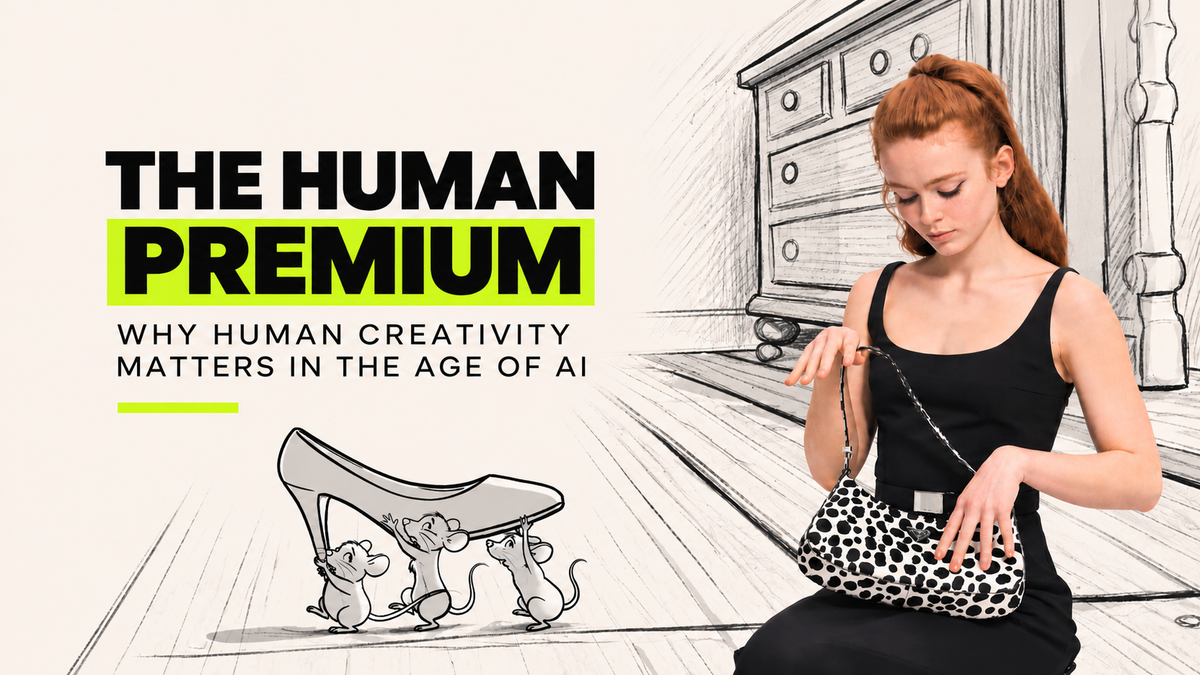
In the age of AI, human creativity has become a luxury.
As machines make creative production faster, cheaper and more accessible, the human touch may become harder to overlook. Prada’s hand-drawn holiday campaign offers a glimpse of why.

We are entering an era in which almost anyone can produce an image, illustration or visual concept with a few words and a prompt. Creative tools that once demanded specialist skills, expensive equipment and hours of work are becoming faster and more accessible. The volume of content this makes possible is extraordinary.
But as the ability to generate becomes commonplace, a different question starts to matter: what makes something feel original?
A recent Prada campaign offers an interesting way into that question. Rather than leaning into digital spectacle, the fashion house has turned towards the distinctly human language of hand-drawn illustration.
Prada makes a case for the human touch
For its 2026 holiday campaign, titled Drawing Prada, Prada built a whimsical illustrated world around a cast that includes Sadie Sink, Maya Hawke, Chen Haoyu, Luther Ford and Kelvin Harrison Jr. The campaign places its subjects inside storybook-like winter scenes, where illustrated landscapes and playful characters blur the boundary between photography and animation.

The hand-drawn illustrations were created by animator John Pomeroy and his team, while the campaign was photographed by Glen Luchford. Hypebae reports that the project did not involve AI. Instead, it foregrounds the work of artists and animators, with the illustrated environments carefully integrated into the photographic scenes.
That choice is notable not because using AI would automatically have made the campaign less valuable, but because the decision to work by hand gives the creative process a visible presence. You can sense the drawing, the construction of the scene and the decisions behind the final image.
When everyone can generate, originality matters more
Generative AI is changing the economics of creative production. It can help people explore ideas, create visual drafts, test different directions and produce material at a speed that would have been difficult to imagine only a few years ago.
That wider access is meaningful. It gives more people the ability to experiment and communicate visually, including people who may not have had the time, training or resources to use traditional creative tools.
But abundance changes the question. When polished images become easier to produce, polish alone may become a weaker signal of distinction. The things that help creative work stand apart may be the ideas behind it: a recognisable point of view, a deliberate choice, an unexpected detail or a process that gives the work its character.
This doesn't mean that AI-generated work cannot be original, or that human-made work is automatically good. Nor does it mean that audiences will always prefer something made by hand. It suggests something more subtle: as the supply of generated content grows, people may pay closer attention to the qualities that make a piece feel distinctive and meaningful.
What makes something feel human?
There is no single formula for human creativity. But three qualities help explain why craft and authorship can make a difference.
01 — Intention
Creative work begins with choices. What is the idea? What should the audience feel or notice? What should be left out? A strong creative point of view gives a piece direction beyond simply making something visually appealing.
02 — Craft
Technique, repetition, experimentation and skill shape the result. In hand-drawn animation, every line and movement reflects a series of decisions. The labour is not necessarily the point, but it can become part of what makes the work compelling.
03 — Character
Individual expression often appears in details that are difficult to standardise: an unusual composition, a particular rhythm, a line that is slightly imperfect or a surprising creative choice. Those details can give work a recognisable personality.

There is also value in knowing who made something and how it came to exist. That context can deepen the relationship between an audience and a piece of work. In a digital environment where images can be detached from their origins and circulated instantly, provenance and process may become more important to people deciding what to trust, value or remember.
The future isn't simply human versus AI
It would be a mistake to treat this as a contest in which one side must win. AI is already becoming part of creative workflows, and its role will continue to evolve. Artists may use it to explore possibilities, automate repetitive tasks or extend what they can make. Others will choose to work with traditional materials precisely because those methods offer a different experience and result.
The more useful question is not whether a tool is involved, but what the creator is trying to achieve and what the tool contributes. Technology can expand the possibilities of creative work. It does not remove the importance of judgement, taste, intention or responsibility for the final result.

For brands, artists and creative organisations, that could mean thinking more carefully about what they want their work to communicate. A distinctive creative identity may become more valuable than simply producing more content. Showing the process, crediting the people involved and making deliberate choices about tools can all help audiences understand what they are looking at.
The human premium
Prada’s hand-drawn campaign is one example, not proof of a universal shift in taste. But it captures a tension that is becoming increasingly relevant: the easier it becomes to make something that looks finished, the more we may look for the thinking, skill and perspective that make it worth paying attention to.
Perhaps the future creative advantage won't come from rejecting new tools, or from using them for everything. It will come from knowing when technology helps, when human judgement matters and what makes an idea worth bringing into the world in the first place.
In a world that can generate almost anything, the most compelling work may be the work with something to say — and a clear sense of who is saying it.
Less noise.
More meaning.
Truffle Culture translates the ideas, technologies and cultural shifts shaping our world into clear, engaging stories.
Explore Truffle Culture →