What Is Mogging? The Internet Slang Turning Everything Into a Competition
Mogging has gone from niche internet slang to Collins Dictionary’s Word of the Year for 2026. But what does it actually mean, where did it come from, and why has the idea of outshining someone become such a recognisable part of online culture?

Digital Culture
Mogging and the New Language of Online Competition
A term born in niche appearance-focused forums has become a flexible joke about who wins, who loses and why so much of life now feels publicly rankable.

Collins Dictionary has named “mogging” its 2026 Word of the Year, according to the supplied brief. The word is blunt, comic and immediately intelligible once encountered in use: to mog someone is to outshine them so completely that the other person appears diminished by comparison.
Its earliest associations were physical. Height, muscularity and conventional attractiveness were central to the term’s use in bodybuilding and masculinity-focused online spaces, where visual traits could be treated as evidence of rank. But the word has since escaped that narrow setting. An outfit can mog another outfit; an athlete can mog a rival; even a video game can mog its competition.
That expansion is what makes mogging worth examining. It is not simply a new word for looking good or doing well. It makes comparison the central event. In a digital culture built around feeds, metrics, self-presentation and rapid reaction, mogging offers a compact way to narrate the world as a visible contest.
A word built around the comparison
To mog is not merely to possess an appealing quality. It is to possess it in relation to somebody else. The term implies a gap wide enough to be conspicuous: one person’s style, physique, confidence or achievement makes another seem less impressive. Its energy comes from exaggeration, which helps explain why it has become useful in memes and playful posts.
Yet the joke has a sharper edge than ordinary praise. Saying that someone looks good can remain descriptive; saying they mog someone else creates a winner and a loser. The distinction matters because the language of online comparison rarely stays confined to a single image. It can turn a moment of admiration into a running assessment of relative status.

From AMOG to a broader internet vocabulary
Mogging is widely believed to have emerged around 2016 in bodybuilding and masculinity spaces, and is often linked to AMOG, or “Alpha Male of the Group.” The derivation is a widely cited belief rather than a proven linguistic origin. Still, the association captures the term’s original atmosphere: a set of online communities preoccupied with dominance, hierarchy and the supposedly legible signs of social standing.
As it travelled through TikTok, meme culture and influencer-led online conversation, its application widened. The word can now be deployed with irony and without a serious claim about human worth. A dramatic entrance, a strong performance or a particularly effective outfit may be said to mog its alternative. That flexibility has made the term more shareable, while preserving its underlying logic of one thing eclipsing another.

Mogging turns admiration into a contest, and online life supplies the scoreboard.
When life is organised as a scorecard
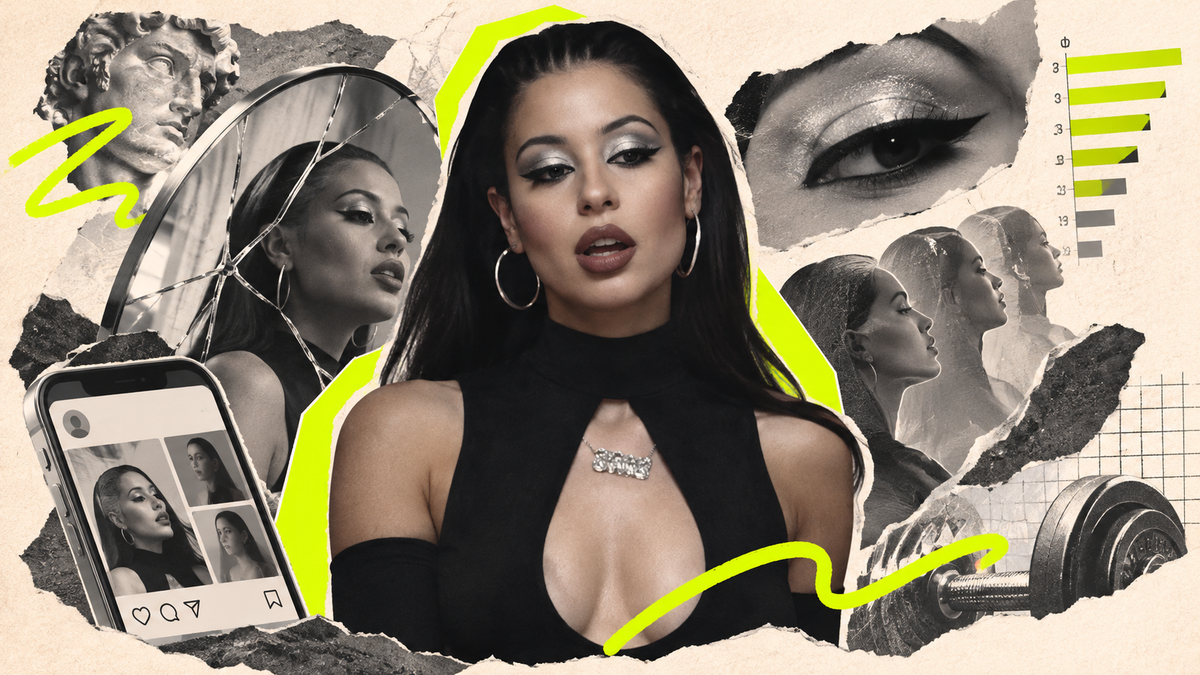
The current use of mogging reaches across three overlapping territories: appearance, status and performance. Appearance remains the most obvious field, encompassing height, muscularity and conventional attractiveness. But fashion, wealth, charisma and social presence can also become comparison material, while sport and entertainment supply a performance version of the same idea: a standout athlete or new game makes a counterpart look weak.
This is not a claim that everyone using the word believes in a rigid social hierarchy. Much of its contemporary use is knowingly theatrical. Still, the term is revealing because it packages a scorecard mentality in casual slang. Social media does not create the human urge to compare, but it can make comparison feel continuous, public and easy to visualise—an endless sequence of bodies, purchases, achievements and personalities placed side by side.

The joke and the pressure beneath it
Mogging should not be confused with looksmaxxing. Looksmaxxing describes efforts to optimise one’s appearance; mogging describes outshining another person. The first is oriented toward self-improvement, however narrowly defined. The second is relational. In practice, the two can meet in online spaces that treat facial features, body composition and height as if they form an objective and permanent ranking system.
That is where apparently light internet language can carry more weight. Some influencers present appearance metrics with a confidence that exceeds their credible support, inviting audiences to mistake subjective ideals for settled facts. Mogging does not cause that culture, and its playful use should not be collapsed into its harshest versions. But the word can make a punitive way of seeing people feel fluent, funny and normal.
What the word reveals about visibility
The appeal of mogging lies partly in its efficiency. It can describe the spectacle of someone excelling, the absurdity of internet bravado or the feeling that a rival has been unmistakably eclipsed. Like much durable slang, it is portable: it moves easily from niche communities into jokes, captions and everyday commentary because it gives a name to a recognisable social dynamic.
But its journey also shows how quickly online culture converts observation into ranking. A feed encourages comparison not only through overt popularity measures, but through repetition: another image, another transformation, another luxury purchase, another performance to assess. Under those conditions, the question is often no longer simply what is good, interesting or attractive. It becomes who wins.
The most useful response is not to treat every use of mogging as evidence of a grim cultural decline, nor to dismiss the term as harmless banter. It is to notice the framework it carries. The word names an old impulse, comparison, in a form shaped by the visibility and velocity of digital life—and asks us to consider how often we accept competition as the default way of looking at one another.
The world, explained
Less noise.
More meaning.
Truffle Culture makes sense of the ideas, people and technologies shaping what comes next.
Explore Truffle Culture →