Cosmic Escapism: Why Stargazing Is Becoming the Ultimate Antidote to Modern Life
Cosmic escapism is rising as people turn to stargazing for relief from digital overload and anxiety. The night sky offers awe, perspective and stillness, emerging as a powerful new form of wellness in modern culture.
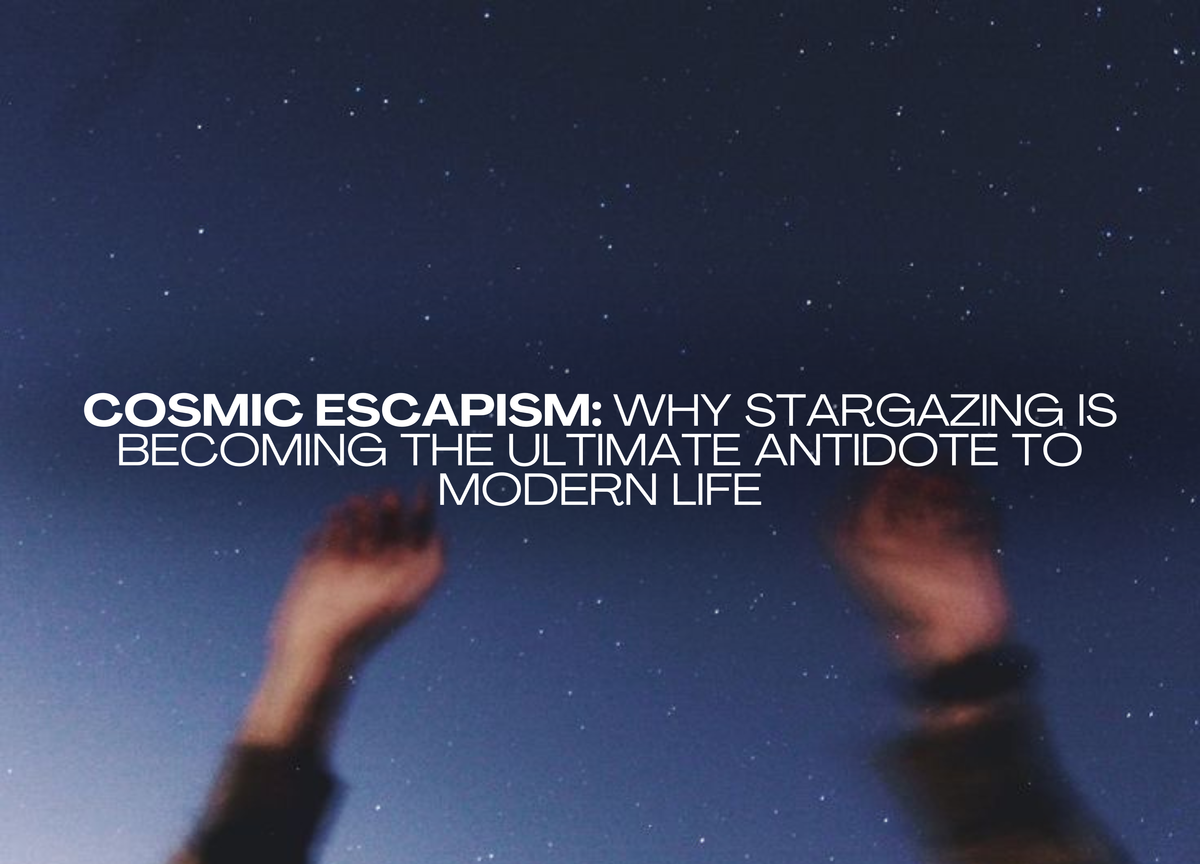
Why Stargazing Is Becoming a Cultural Antidote to Modern Life
There is a quiet shift happening at the edge of culture. It is not loud enough to dominate headlines, nor polarizing enough to fracture opinion; it does not trend with the heat of outrage or spike with the volatility of markets. Instead, it unfolds slowly, almost imperceptibly, in the margins of everyday life. People are looking up again—not metaphorically, but literally. Across cities, deserts, and increasingly curated travel destinations, individuals are stepping into the night to track lunar cycles, book dark-sky retreats, and plan holidays around meteor showers. While this may appear to be simple nostalgia—a romantic return to nature in a high-tech era—such an interpretation misses the deeper signal. This is not a return; it is a recalibration.
Cosmic escapism is emerging as a powerful cultural response to a world defined by compression and relentless proximity. To understand why the night sky is becoming relevant again, one must first understand what has happened to the scale of modern existence. Life has undergone a radical condensation where time, space, and attention are flattened into the continuous scroll of a smartphone. In this "experiential claustrophobia," news, identity, and global crises coexist in a single feed, making the world feel immediate and urgent. The more connected we become, the more overwhelmed we feel. In this context, the desire for expansion becomes inevitable.
The Return of Scale and the End of Optimisation
The night sky offers a literal, immeasurable vastness that modern life has systematically removed. Psychological research into "awe" experiences suggests that exposure to such vastness reduces anxiety and diminishes focus on personal concerns. Astronauts call this the Overview Effect—a cognitive shift where borders disappear and humanity is perceived as a single, fragile system. Stargazing offers a terrestrial version of this shift, reintroducing distance into a culture defined by proximity.
This movement also signals a fracture in the traditional wellness paradigm. For a decade, wellness was synonymous with optimization: tracking sleep, engineering diets, and measuring productivity. However, the rise of "star bathing" and dark-sky tourism suggests a pivot toward meaning over metrics. Stargazing resists quantification; it cannot be optimized or controlled. By engaging with a system that exists independently of human logic, individuals are moving away from self-improvement and toward experiences that dissolve the self entirely.
Darkness as the New Luxury
One of the most overlooked drivers of this trend is the increasing scarcity of darkness. As light pollution erases the Milky Way from the suburban and urban experience, natural darkness is becoming a rare commodity. This has inverted the traditional construction of value. For much of modern consumer culture, value was found in addition—more features, more content, more stimulation. Today, value is increasingly found in subtraction: the removal of noise, light, and distraction. Darkness has become a luxury.
This behavioral shift was accelerated by the pandemic. During lockdowns, when movement was restricted and human systems felt fragile, the night sky provided a sense of continuity and stability. The fact that this behavior has persisted beyond the crisis suggests it is a lasting imprint. Once the psychological benefits of celestial perspective are felt, the desire to return to that state remains.
From Screen to Cosmos: A Spatial Shift
There is also a profound spatial dimension to this trend. Digital life is inherently two-dimensional, framing the user as the focal point of a curated universe. Under the night sky, this dynamic is reversed. The individual is not the center, but a small part of a vast system. This shift can be destabilizing, but it is ultimately grounding, offering a form of relief from the pressure of self-centrality.
This influence is already bleeding into the cultural aesthetic. There is a growing appetite for stillness, negative space, and minimalism in design and film—a "cultural aesthetic of stillness" that mirrors the slow, patient unfolding of the cosmos. As digital saturation increases, the night sky will likely move from a niche interest to a structural necessity.

Implications for the Future
The appeal of cosmic escapism is unlikely to fade. We are likely to see a continued expansion of dark-sky tourism and a reframing of the night as a space for intentional disengagement. For brands and institutions, this presents a unique challenge: the appeal of the cosmos lies in its resistance to manipulation. Brands that succeed here will be those that facilitate access rather than attempt to control or commercialize the experience.
For policymakers, access to darkness may eventually need to be treated as a public good, essential for psychological resilience. While cosmic escapism lacks the urgency of political conflict, its quietness is precisely what makes it significant. It reveals a profound need for expansion in a world that has grown too small. In looking up, we are not retreating from reality; we are resizing it.