The K-Shaped Economy Is Breaking the Middle
The K-shaped economy is breaking the middle. As affluent consumers keep spending and everyone else cuts back, brands caught between affordability and aspiration are losing relevance. Truffle Culture explores what this means for consumer behaviour, culture and growth.
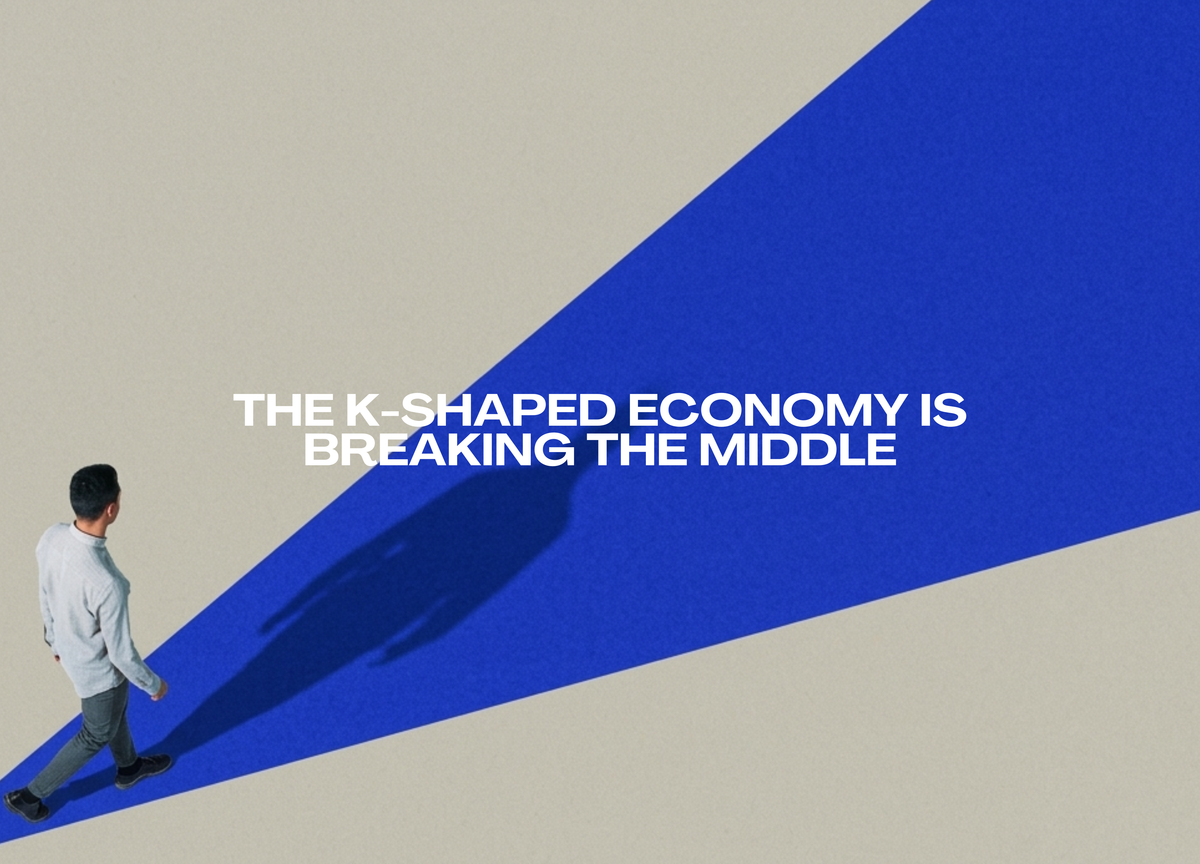
The K-Shaped Economy Is Breaking the Middle. For years, the middle was where brands wanted to live.
It was the sweet spot of modern consumer capitalism: broad enough to scale, aspirational enough to grow, affordable enough to feel democratic. The middle promised reach. It promised volume. It promised relevance without the risk of becoming either too cheap or too rarefied.
That promise now looks increasingly unstable.
The K-shaped economy is often described as a split between those rising and those falling behind. But for brands, the more revealing story is not simply inequality at the top and hardship at the bottom. It is the collapse of the centre. As spending power concentrates among wealthier consumers and financial pressure intensifies for everyone else, the middle of the market is starting to lose both its economic force and its cultural meaning.
This is the signal.
The old mass-market logic assumed a relatively shared consumer reality. People might sit at different points on the same ladder of aspiration, but they were still on the same ladder. That assumption no longer holds. Increasingly, consumers are living in two different economies at once. One buys with insulation. The other buys with constraint. One spends through rising asset values, higher incomes and financial cushioning. The other navigates everyday life through substitution, postponement, smaller baskets and private-label trade-offs.
The line between those two worlds is becoming harder to ignore.
Bloomberg reported in 2025, citing Moody’s Analytics analysis of Federal Reserve data, that the top 10 percent of US earners accounted for 49.2 percent of all consumer spending in the second quarter of the year, the highest share in records going back to 1989. Put differently, 90 percent of the population accounted for just over half of all spending. The broad consumer base that once powered mass growth is no longer carrying the economy in the same way. It is being outspent by a narrow, affluent tier whose purchasing power increasingly determines what growth looks like.¹
That kind of concentration changes more than economic modelling. It changes the conditions under which brands compete.
When a greater share of demand comes from consumers who are relatively protected, premium products, elevated experiences and high-margin categories continue to find buyers. But at the same time, the rest of the market becomes more price-sensitive, more selective and less forgiving. Households under pressure do not browse in the same way. They calculate. They compare. They cut. According to Bank of America Institute data reported by MarketWatch in February 2026, spending growth among upper-income households was 2.5 percent year-on-year, compared with 1.0 percent for middle-income households and just 0.3 percent for lower-income households. The gap in after-tax wage growth between higher- and middle-income earners was the widest in nearly five years.²
This is where the K-shape stops being an abstract economic phrase and starts becoming a cultural reality.
Consumers are no longer shopping along a single arc of aspiration. They are splitting into two different logics. One is trading down for price. The other is trading up for meaning, status, quality or durability. The brands caught in the middle are discovering that being broadly acceptable is no longer enough.
That is the real pressure point.
Middle-market brands used to benefit from ambiguity. They could be reasonably priced, reasonably good, reasonably desirable. In a more unified economy, that made sense. In a fractured one, it becomes a liability. Consumers who need relief want a clear deal. Consumers who can still stretch want a clear reason. The middle often offers neither with enough conviction.
In other words, the K-shaped economy is not just dividing wallets. It is polarising value.
This is already visible in how consumer behaviour is being reshaped by persistent financial strain. BCG reported in January 2026 that inflation and household pressure were driving consumers toward lower-priced alternatives, private-label goods and, in some cases, category exit altogether. Its late-2025 Global Consumer Radar found that many consumers expected to spend more only because prices remained high, not because confidence or discretionary freedom had returned. Categories such as apparel, snacks, prepared foods and alcohol were among those likely to see cutbacks.³
What matters here is not just that people are spending differently. It is that the symbolic role of spending is becoming more extreme. In a divided economy, purchases have to work harder.
A cheaper product is not just cheaper. It signals control, discipline, practical intelligence, an ability to survive the squeeze without losing face. A premium product is not just premium. It signals discernment, reward, insulation, quality, taste, perhaps even permanence in an era where everything else feels compromised. The middle, by contrast, increasingly risks looking like the least coherent option of all. Not secure enough to feel easy. Not special enough to feel worth the stretch.
That is why brands stuck in the middle are not just losing on price. They are losing on meaning.
This matters because the middle has historically been where some of the biggest, most recognisable consumer companies were built. The supermarket staple. The everyday fashion retailer. The accessible beauty line. The familiar restaurant chain. The well-priced homeware brand. Entire sectors were designed around the idea that the centre could absorb an enormous amount of volume. But if the centre no longer feels like a stable consumer identity, then “mass” stops functioning as a safe strategy.
The K-shaped economy does not eliminate the mass market overnight. But it does make the old middle-market promise harder to sustain. Brands that once relied on being broadly appealing now face a tougher question: broadly appealing to whom?
This is also where a lot of lazy business thinking goes wrong. Faced with a squeezed middle, it is tempting to declare premiumization the obvious answer. If consumers at the top are still spending, then surely the route forward is to move upscale, raise prices and position for aspiration.
The problem is that premiumisation only works when the premium feels earned.
Luxury’s own recent wobble shows this clearly. Bain & Company reported in 2025 that the global luxury customer base had shrunk from around 400 million in 2022 to approximately 340 million in 2025, with repeated price increases contributing to consumer fatigue and alienation. Reuters, covering Bain’s analysis, reported that some shoppers felt “betrayed” by relentless price hikes that no longer seemed matched by value, quality or emotional payoff.⁴
That is a warning sign for everyone else.
Consumers may still trade up, but they are becoming more exacting about why. The premium end of the market is not immune to disbelief. It can still overreach. It can still lose trust. It can still confuse expense with distinction. So while the K-shaped economy rewards some forms of premium demand, it does not hand out permission to charge more without consequence.
Which brings us back to the real strategic question. In a split economy, what wins is not simply premium or budget. It is clarity.
The brands best positioned for this moment are not necessarily the most expensive or the cheapest. They are the ones that are unmistakable in the role they play. They are clearly better, clearly cheaper, clearly more useful, clearly more durable, clearly more identity-rich, or clearly more emotionally resonant. They do not sit in the market hoping consumers will fill in the blanks.
That kind of precision matters more when the middle is thinning out. When people are forced into sharper decisions, fuzzy positioning becomes a tax on attention. Consumers under pressure do not reward vagueness. Affluent consumers do not need it.
This is why the K-shaped economy is such an important signal for culture, not just commerce. It tells us that economic divergence is no longer something happening in the background while brands continue speaking to an imaginary average. The average is becoming less persuasive as a category. Consumer life is splitting into distinct realities, and those realities produce different desires, different anxieties and different thresholds for what feels worth buying.
For culture, that means class will become more visible in ordinary consumption. Not only in luxury purchases, but in supermarket choices, beauty routines, restaurant habits, holidays, wellness, convenience, subscriptions and the small rituals of everyday life. The divide will not always announce itself loudly. Often it will appear through subtle differences in what feels routine, what feels indulgent and what feels newly out of reach.
For brands, it means the collapse of spending power in the broad middle is not a temporary inconvenience. It is a structural constraint on growth. There is less room for safe, generic propositions built around moderate quality at moderate prices for a supposedly universal customer. The new question is more pointed: are you delivering relief, or are you delivering reason?
For power, it suggests something even more consequential. Companies that can capture affluent demand without losing strategic discipline, or serve price-sensitive consumers without hollowing out margin and trust, will hold an increasingly disproportionate advantage. Everyone else will be forced into harder choices, from portfolio restructuring to sharper segmentation to an honest reappraisal of whether their category position still makes sense.
This does not mean every brand should flee the middle. But it does mean the middle can no longer be treated as a neutral zone. It has become a high-risk space, precisely because it looks familiar while behaving very differently.
The K-shaped economy is breaking the middle because it is breaking the illusion of a shared consumer centre. One part of the market is buying through protection. Another is buying through pressure. Brands built for a world in which those realities could be addressed with the same offer are now discovering that average has become a much more fragile proposition.
The age of broad comfort is giving way to the age of hard choices.
And in that landscape, the brands that survive will not be the ones that try to be everything to everyone. They will be the ones that know exactly what kind of value they offer, exactly who it is for, and exactly why it matters now.
What this signal may lead to next
Expect more brands to sharpen their price architecture, split product tiers more aggressively and retreat from vague middle-market positioning. Some will double down on value. Others will refine premium propositions. Many will discover that the safest place to stand is no longer the centre, but a more legible edge.
Implications for culture, brands and power
Culture will become more visibly stratified through ordinary consumption. Brands will need to choose whether they are offering relief, status, utility or emotional justification. Power will increasingly accrue to companies that understand that consumer choice is no longer operating on one continuum, but across two diverging realities.
Who should pay attention
Consumer brands, retailers, hospitality groups, beauty and fashion operators, investors, strategists and founders still building for an imagined mainstream. The middle is not disappearing, but it is becoming a far more unstable place to build from.
References
- Bloomberg, “The Top 10% of Americans Are Responsible for Half of All US Consumer Spending,” citing Moody’s Analytics analysis of Federal Reserve data, 2025. Also supported by Morgan Stanley’s 2025 K-shaped economy analysis.
- MarketWatch, reporting Bank of America Institute data on household spending growth by income tier, February 2026.
- BCG, January 2026 consumer report on inflation and household pressure; BCG Global Consumer Radar, late 2025 findings on category cutbacks and inflation-led spending expectations.
- Bain & Company, luxury market analysis, 2025; Reuters coverage of Bain’s findings on shrinking luxury customer numbers and consumer backlash to price increases.
- The Washington Post, January 2026, on the economy’s dependence on affluent consumer spending and the fragility of narrow growth pillars.