Are Reboots Killing Culture?
Are reboots preserving culture or rewriting it? Using HBO’s Harry Potter series as a lens, this Truffle Culture editorial explores how nostalgia, streaming, and fandom are reshaping cultural legacy.
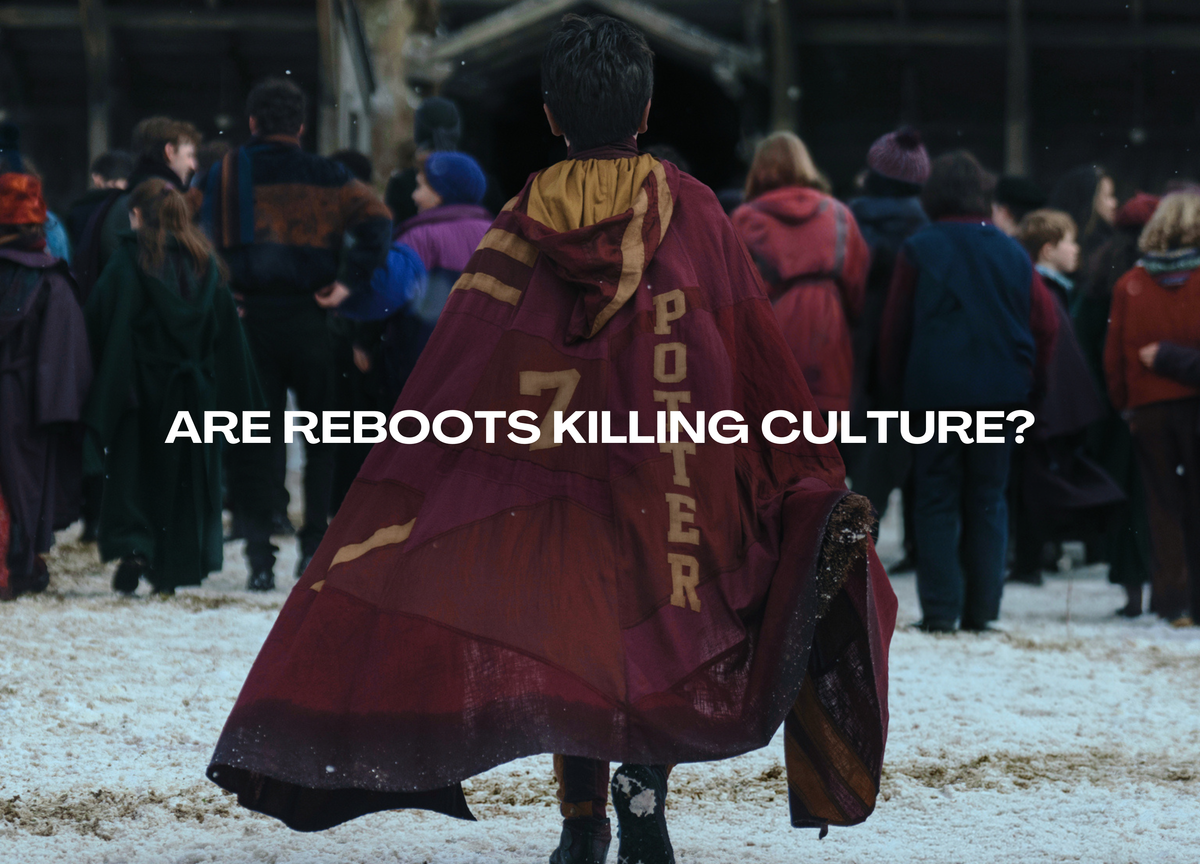
The HBO Harry Potter Series and the Battle Over Legacy
When HBO announced its long-form television adaptation of Harry Potter, the reaction was immediate and revealing. It was not simply excitement, nor was it outright resistance. Instead, it surfaced something more complex and more telling: a quiet tension over what it means to revisit a cultural artefact that has already defined a generation.
This is not just another reboot entering an already saturated entertainment landscape. It is a deliberate return to one of the most culturally embedded narratives of the past twenty-five years, rebuilt for a radically different media environment. Produced by HBO, the series promises a faithful, season-by-season retelling of the original books, offering greater depth, expanded character arcs, and a level of narrative fidelity that the original films could never fully achieve within their constraints.
On the surface, this appears to be an act of preservation. A chance to restore what was lost in adaptation and to introduce the story to a new generation with renewed clarity. Yet beneath that promise lies a more unsettling possibility. What if reboots are not preserving culture at all, but subtly reshaping it in ways that alter how it is remembered, experienced, and ultimately understood?
The Promise of Preservation
Reboots have always been framed as acts of cultural care. They arrive with the implicit suggestion that important stories deserve to endure, to be retold and refreshed so they remain accessible across generations. In theory, this is a form of stewardship. It acknowledges the value of a narrative while recognising that cultural relevance is not static.
The HBO Harry Potter series embodies this logic with precision. By dedicating an entire season to each book, the adaptation creates space for narrative elements that were previously condensed or omitted. Secondary characters can be more fully realised, thematic nuances can be explored in greater detail, and the pacing can more closely mirror the source material. For readers who long felt that the films sacrificed depth for spectacle, this approach offers a compelling corrective.
However, preservation in culture is rarely neutral. To retell a story is to reinterpret it, even when the intention is fidelity. Choices must be made about tone, emphasis, casting, and visual language. These decisions inevitably reflect the context in which the reboot is produced, not the one in which the original emerged. As a result, preservation becomes entangled with transformation.
Memory, Not Just Material
The tension surrounding the HBO series is not rooted in the text of Harry Potter alone. It is rooted in memory. For millions of people, the story is inseparable from the specific way it was first encountered. The original film series, beginning with Harry Potter and the Philosopher’s Stone, did more than translate the books into a visual medium. It established a shared cultural reference point that has endured for over two decades.
Characters were not just imagined; they were embodied. Settings were not just described; they were visualised in a way that became collectively accepted. The films created a fixed aesthetic and emotional framework through which the story has been understood ever since. This is how cultural legacy is formed. It is not only about the original material, but about the version of that material that achieves the widest and most enduring recognition.
A reboot inevitably disrupts this framework. By introducing new actors, new interpretations, and new visual choices, it challenges the stability of those shared references. The question then shifts from what the story is to which version of the story holds authority. This is where the concept of legacy begins to fracture.
The Infrastructure of Streaming
To understand why this moment feels particularly charged, it is necessary to consider the broader context in which it is unfolding. The rise of streaming platforms has fundamentally altered how cultural content is produced, distributed, and consumed. Companies like HBO are not simply creating individual shows; they are building ecosystems designed to maximise engagement, retention, and long-term value.
Within this system, legacy intellectual property becomes an incredibly powerful asset. Recognisable stories reduce the risk associated with new productions, while established fanbases provide a built-in audience. Reboots are therefore not just creative decisions; they are strategic ones, designed to anchor platforms in a competitive and attention-saturated market.
The HBO Harry Potter series sits squarely within this logic. It is both a cultural project and a commercial strategy, leveraging familiarity to secure relevance in an increasingly fragmented media landscape. This dual function complicates the narrative of preservation. The goal is not simply to honour the past, but to ensure that it continues to generate value in the present.
When Versions Compete
One of the most significant shifts introduced by the streaming era is the way in which different versions of a story coexist. In the past, a remake might sit alongside the original without directly challenging its dominance. Audiences had access to both, but discovery was less algorithmically mediated.
Today, platforms actively shape what is visible. They prioritise new releases, promote certain titles, and guide user behaviour through recommendation systems. This creates a subtle but important dynamic in which newer versions can gradually displace older ones in terms of cultural visibility.
For younger audiences encountering Harry Potter for the first time, the HBO series may become the primary point of entry. Their understanding of the story will be shaped by this version, not the films that defined it for previous generations. Over time, this shift in first exposure can lead to a broader reconfiguration of cultural memory.
The original does not disappear, but it becomes less central. Its authority is diluted, not through erasure, but through competition.
Casting and Cultural Identity
Few aspects of a reboot generate as much immediate scrutiny as casting. In the case of Harry Potter, this scrutiny is intensified by the deep emotional attachment audiences have to the original actors. These performances have become inseparable from the characters themselves, embedding specific faces and voices into the collective imagination.
Recasting these roles is therefore not a purely practical decision. It is a symbolic act that redefines how those characters are perceived. The new HBO cast will inevitably be evaluated against the existing benchmark, with every performance subject to comparison and critique.
This dynamic reflects a broader shift in audience behaviour. Fans are no longer passive recipients of cultural products. They actively participate in shaping discourse, using social media to voice opinions, challenge decisions, and influence perception. In this sense, fandom operates as a form of cultural governance, exerting pressure on creators and institutions alike.
Reboots, then, are not just creative endeavours. They are negotiations between producers and audiences, played out in real time.
The End of Nostalgic Safety
For much of the late twentieth and early twenty-first centuries, nostalgia functioned as a reliable foundation for reboots. Familiarity was enough to generate goodwill, and audiences were often willing to overlook imperfections in exchange for the comfort of revisiting a beloved story.
That dynamic has changed. Nostalgia no longer guarantees acceptance. Instead, it raises the stakes. The more significant a cultural property is, the more closely it is scrutinised, and the more fiercely it is defended.
Harry Potter exemplifies this shift. Its cultural footprint is vast, spanning literature, film, merchandise, and theme parks. It is not simply a story, but a shared cultural experience that has shaped identities and communities. Rebooting such a property is inherently risky, precisely because of its importance.
The result is a paradox. The very factors that make a reboot attractive also make it vulnerable.
The Gradual Shift of Meaning
The most profound impact of reboots may not be immediately visible. Rather than dramatically altering a story in a single moment, they introduce incremental changes that accumulate over time. A different interpretation of a character, a shift in tone, or an updated thematic emphasis may seem minor in isolation. Yet as these elements are layered across multiple iterations, they begin to reshape the overall meaning of the narrative.
This process is not unique to modern media. Stories have always evolved through retelling. What is distinctive about the current moment is the speed and scale at which this evolution occurs. Global platforms enable rapid dissemination, while digital discourse accelerates interpretation and feedback.
As a result, cultural meaning becomes more fluid and more contested. The “definitive” version of a story is no longer fixed, but continually renegotiated.
Culture as a Living System
To suggest that reboots are killing culture is to assume that culture is something static, capable of being preserved in a fixed form. In reality, culture has always been dynamic. It adapts, evolves, and responds to the contexts in which it exists.
From this perspective, reboots can be understood not as threats, but as mechanisms of continuity. They allow stories to remain relevant, to be reinterpreted in ways that resonate with contemporary audiences. Without this process, cultural artefacts risk becoming obsolete, confined to the contexts in which they were originally created.
However, this does not mean that all reboots are inherently beneficial. The challenge lies in balancing preservation with transformation, ensuring that the core essence of a story is not lost in the process of updating it.
What This Signals Next
The HBO Harry Potter series is part of a broader trend in which legacy intellectual property is treated as a renewable resource. Stories are no longer finite; they are continuously revisited, expanded, and reimagined. This approach reflects both technological capabilities and economic incentives, aligning creative output with platform-driven models of engagement.
Looking ahead, it is likely that this pattern will intensify. More franchises will undergo similar transformations, and the distinction between original and reboot will become increasingly blurred. At the same time, audiences will continue to play a more active role in shaping outcomes, influencing not only reception but also production decisions.
This creates a cultural landscape in which authority is distributed rather than centralised. Stories are not owned in a singular sense; they are collectively negotiated.
Implications for Culture, Brands, and Power
For cultural institutions, this shift demands a new approach to stewardship. Managing a legacy property now involves navigating a complex interplay of nostalgia, innovation, and audience expectation. Success depends not only on creative execution, but on the ability to engage with an increasingly participatory audience.
For brands, the lesson is equally clear. Nostalgia can attract attention, but it cannot sustain it on its own. Audiences expect meaningful engagement with the source material, combined with a clear sense of purpose for its reinterpretation.
For platforms, legacy IP represents both an opportunity and a risk. While it can drive engagement, it also carries the potential for backlash if handled poorly. The margin for error is narrow, particularly when dealing with culturally significant properties.
Who Should Pay Attention
This shift has implications that extend far beyond the entertainment industry. Founders, investors, and strategists operating in any cultural or content-driven space should take note of how legacy is being managed and transformed. The dynamics at play in the HBO Harry Potter series are indicative of broader changes in how value is created and sustained in a digital environment.
Understanding these dynamics is essential for anyone seeking to navigate the intersection of culture, technology, and business. The ability to anticipate how stories evolve, and how audiences respond, will become an increasingly valuable skill.
The Question That Remains
The HBO Harry Potter series will undoubtedly achieve a level of success. It will attract attention, generate conversation, and extend the life of a globally recognised narrative. In doing so, it will fulfil many of the objectives that motivated its creation.
Yet its deeper impact will unfold over time. As new audiences engage with this version of the story, and as existing fans reassess their relationship to it, the balance between preservation and transformation will continue to shift.
This is the tension at the heart of the reboot era. Not whether stories are being retold, but how those retellings reshape the cultural landscape.
In the end, the question is not simply whether reboots are killing culture.
It is whether, in the process of keeping it alive, they are quietly turning it into something else entirely.