Why the Nipah Virus Is Going Viral Before the Risk Is Clear
The Nipah virus outbreak is spreading fast across media. What this reveals about post-pandemic fear, risk perception, and cultural power shifts.
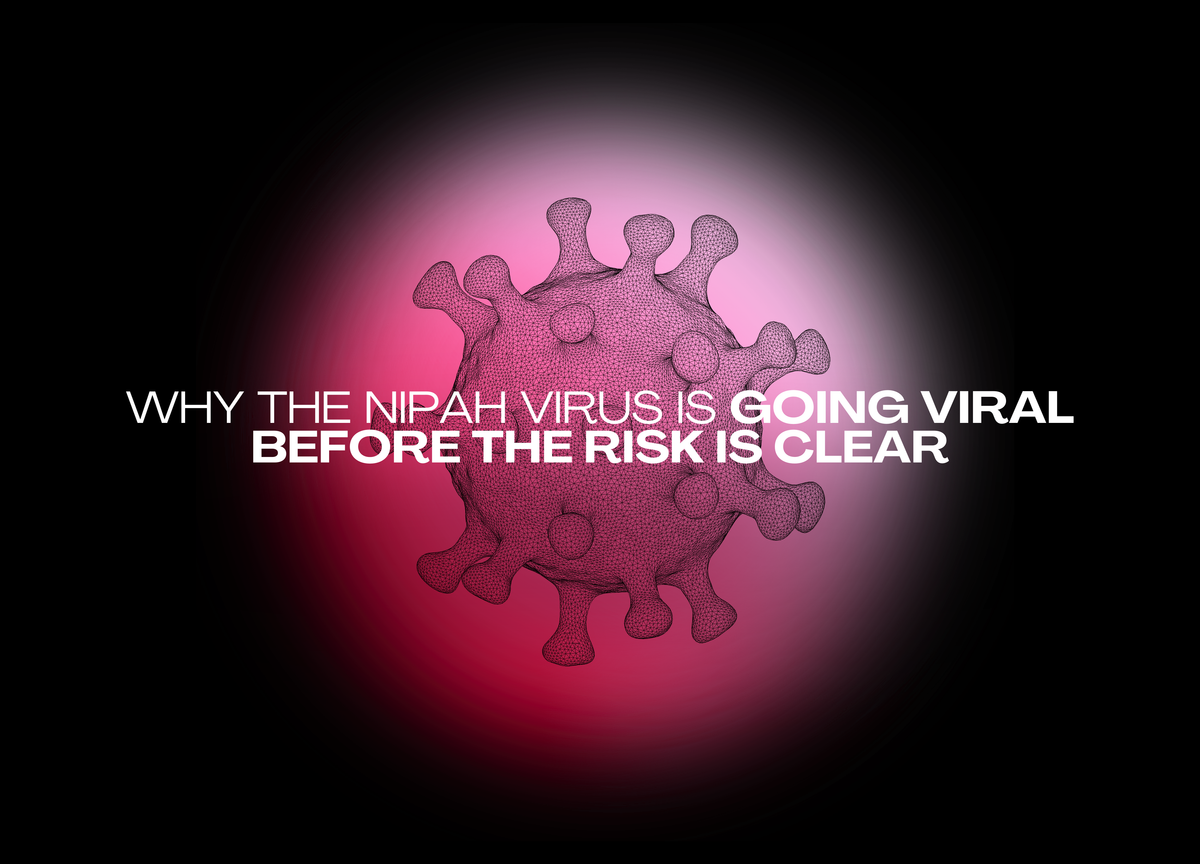
What the sudden amplification of the Nipah outbreak reveals about post-pandemic fear, media dynamics, and how society now processes biological risk.
Signal: Post-Pandemic Risk Amplification
Mentions of a “deadly Nipah virus outbreak” have surged across news feeds and social platforms in recent days. Headlines move quickly. Language escalates faster. Public attention locks in early.
What’s striking is not simply that Nipah is being reported. It’s how fast uncertainty is being framed as imminent threat — long before the public has meaningful context about scale, transmission, or probability.
This pattern has become familiar. Since COVID-19, biological risk now travels through media systems with a unique velocity. Outbreak narratives bypass the usual friction of verification and move directly into cultural consciousness as potential catastrophe.
The Nipah virus, in this sense, is less the story than the trigger.
What This Suggests
The virality of Nipah-related coverage signals a deeper cultural shift: our collective threat perception has been permanently recalibrated.
Pre-2020, disease outbreaks were filtered through distance, probability, and institutional reassurance. Post-pandemic, those buffers are thinner. Biological risk now occupies a privileged position in the hierarchy of fear, capable of dominating attention before evidence stabilises.
This is not irrational panic. It is learned behaviour.
COVID taught societies that early warnings matter, that delays are costly, and that institutional confidence can collapse overnight. As a result, the public now treats early outbreak signals not as background information, but as potential turning points.
Nipah becomes culturally potent not because of what it is today, but because of what it reminds people of.

Why It’s Emerging This Way Now
Several forces are converging:
- Pandemic memory remains unresolved. COVID was not cleanly processed as a historical event; it lingers as an open psychological loop.
- Media systems reward escalation over calibration. “Deadly virus” travels faster than probabilistic nuance.
- Trust in institutions is fragile. In the absence of immediate clarity, people default to amplification rather than waiting.
- Algorithms are primed for biological threat narratives. Health risk now outperforms political and economic risk in early attention cycles.
Together, these forces create a cultural environment where outbreaks like Nipah are experienced first as meaning, not data.
What This May Lead To
If this pattern continues, several trajectories emerge:
- Outbreak narratives will increasingly front-run expert consensus, shaping public perception before institutions can respond.
- Biological risk will crowd out other forms of slow-burn danger, including climate, infrastructure, and social inequality.
- Public fatigue may deepen, as repeated exposure to high-threat framing without resolution erodes trust.
- Institutions may be forced to communicate earlier and more speculatively, changing the norms of public health messaging itself.
This is not about Nipah alone. It’s about a new cultural reflex around uncertainty.
Who Should Pay Attention
- Media organisations, navigating the tension between early warning and amplification
- Public institutions, managing trust in an era of accelerated fear
- Technology platforms, whose systems now shape collective risk perception
- Brands and cultural actors, operating in environments where anxiety travels faster than reassurance
Signal Maturity
Emerging.
The amplification of Nipah reflects a broader post-pandemic pattern that is becoming visible across multiple outbreak stories, but has not yet settled into a stable public norm.
Implications for Culture, Brands, and Power
For culture, the Nipah moment highlights how deeply COVID reshaped our shared psychology. Biological threats now function as cultural shortcuts, activating fear, memory, and urgency before facts can anchor meaning. Culture is no longer waiting for confirmation; it is responding to resonance.
For brands, this environment demands restraint. Opportunistic engagement with health-related virality risks backlash and erosion of trust. Credibility will increasingly be built through silence, timing, and alignment with verified information rather than speed.
For power, the balance has shifted. Institutions no longer control the opening narrative in moments of uncertainty. Attention forms first, authority follows later. Managing public trust will depend less on certainty and more on transparency about what is not yet known.
The Nipah virus may or may not escalate into something structurally significant from a public health perspective. It is too early to say. But culturally, its rapid amplification already tells us something important: in a post-pandemic world, fear now arrives before facts — and meaning forms in the gap.
That gap is where power, trust, and culture are increasingly decided.