How Venture Capital Is Shaping Cultural Taste (And Why It Matters Now)
Venture capital is no longer just funding companies. It is embedding itself inside the systems that produce culture, shaping taste, identity, and influence from within.
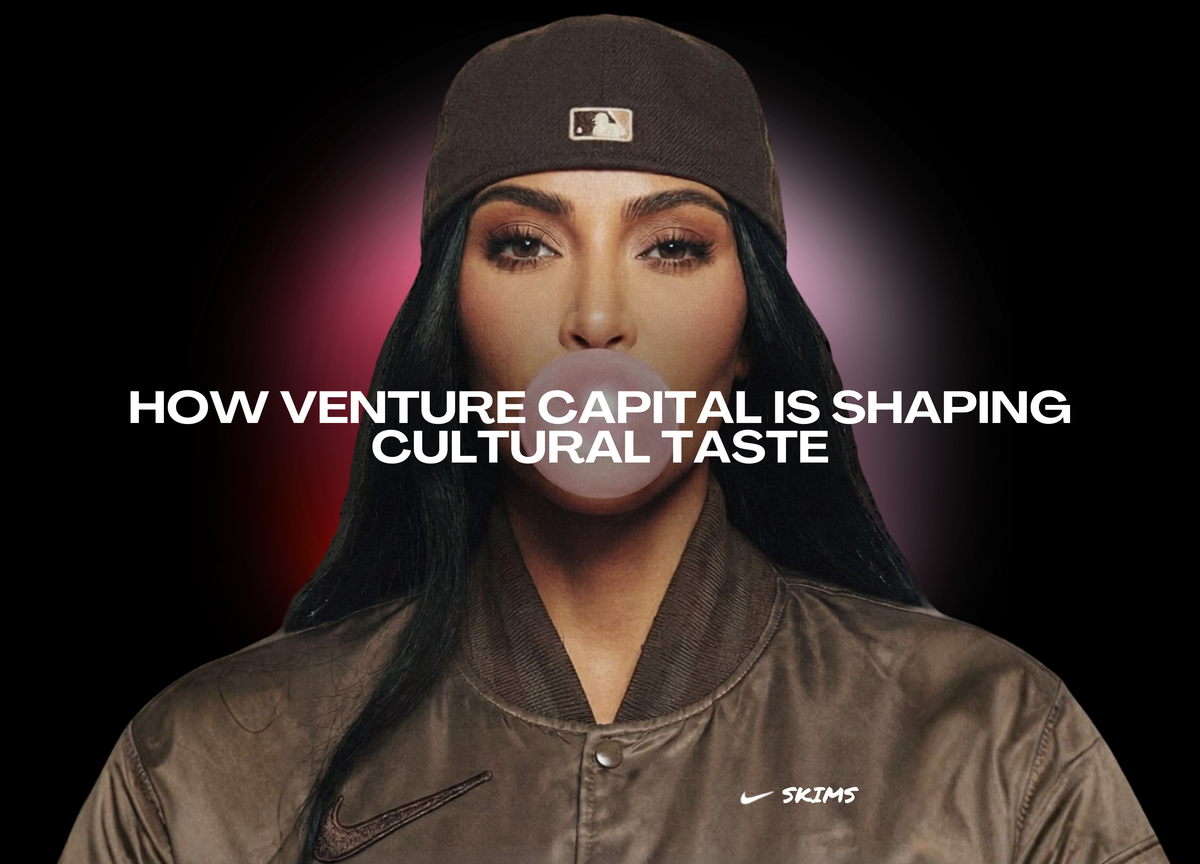
How Venture Capital Is Embedding Itself Inside Cultural Production Systems
A new class of venture capital is no longer content with funding companies at the edge of culture. It is embedding itself within the systems that produce it. From shapewear to cinema, the architecture of taste is being quietly reorganised, and the implications are only just beginning to surface.
There is a particular kind of pattern that only becomes visible once you stop looking at companies as isolated entities and begin to see them as components within a wider system. It is the difference between observing individual cultural moments and understanding the infrastructure that makes those moments possible. Increasingly, the most consequential shifts in culture are not happening on the surface, where trends rise and fall in public view, but beneath it, where capital, networks, and narrative converge to shape what is seen, valued, and ultimately believed.
Consider the trajectory of Thrive Capital, the New York–based investment firm founded by Joshua Kushner. On paper, its portfolio reads like a familiar list of successful consumer and technology companies. It has backed platforms that define how people communicate, consume media, and express identity, including Instagram, Spotify, Twitch, and Patreon. Alongside these sit brands such as Glossier and Warby Parker, which have each redefined their respective categories through a blend of community, aesthetics, and narrative.
The Rise of Capital as a Cultural Architect, Not Just a Financial Backer
Viewed individually, these investments suggest a firm with a strong instinct for consumer behaviour and digital infrastructure. Viewed collectively, they suggest something more deliberate. They map onto the architecture of culture itself.
This becomes more apparent when looking at two of Thrive’s more recent and symbolically potent investments: SKIMS and A24. At first glance, these companies occupy entirely different domains. SKIMS operates in the realm of fashion and body image, producing garments that both respond to and shape contemporary ideals of identity, inclusivity, and desirability. A24, by contrast, operates in the world of cinema, curating a catalogue of films that signal cultural literacy, aesthetic sophistication, and a certain kind of intellectual cool.
Yet both sit at critical points in the production of culture. SKIMS influences how bodies are presented and perceived in everyday life, while A24 shapes the narratives, moods, and visual languages that define contemporary storytelling. One operates on the surface of identity, the other within the symbolic frameworks through which identity is interpreted. When the same capital network backs both, the connection is not operational but structural. It reveals a pattern of investment that spans across the systems through which taste is constructed.
For much of the twentieth century, cultural production was dominated by institutions whose power was both visible and centralised. Hollywood studios controlled film distribution, record labels dictated musical output, and fashion houses defined the boundaries of style. These systems were hierarchical and, in many ways, explicit in their authority. The audience understood, even if implicitly, where power resided.
The digital era appeared to disrupt this model. Platforms promised democratisation. Anyone could create, distribute, and gain visibility without the need for traditional gatekeepers. Culture became faster, more fragmented, and seemingly more participatory. The narrative of decentralisation took hold, and with it came the belief that taste was now shaped from the bottom up.
What has emerged instead is a more complex configuration of power. The gatekeepers did not disappear. They evolved. Rather than controlling production directly, they now operate through networks, platforms, and capital flows that influence what is produced, how it is distributed, and which signals are amplified.
Thrive Capital exemplifies this shift. Its investments are not confined to a single sector or medium. Instead, they are distributed across multiple layers of cultural production. Instagram shapes visual language and social validation. Spotify influences how music is discovered and categorised. Twitch redefines entertainment through live interaction and parasocial relationships. Patreon restructures the economics of creativity, allowing audiences to directly fund the creators they value. Glossier transforms beauty into a participatory, community-driven identity system, while Warby Parker reframes consumer goods through narrative and accessibility.
Each of these companies occupies a different position within the cultural ecosystem. Together, they form an interconnected network through which taste is not only expressed but also produced.
This is where the role of capital becomes more significant. Venture capital has traditionally been understood as a mechanism for identifying promising ideas and scaling them. The assumption is that culture exists independently, and capital simply accelerates what is already there. What is now becoming evident is that capital is increasingly involved earlier in the process, embedding itself within the systems that generate cultural signals in the first place.
The distinction may appear subtle, but its implications are profound. If capital is present at the point of cultural creation, then it is no longer merely responding to taste. It is participating in its formation.
This dynamic is particularly visible in the relationship between SKIMS and A24. SKIMS does not simply sell shapewear. It constructs a narrative around the body that is deeply entwined with celebrity, inclusivity, and digital virality. Its campaigns function as cultural events, designed to be shared, discussed, and embedded within the broader visual language of social media. A24, meanwhile, has built a brand that transcends traditional film production. Its films are not just watched; they are curated, analysed, and integrated into the identity of their audiences. To engage with A24 is to signal a particular kind of taste, one that values subtlety, ambiguity, and aesthetic coherence.
When these two entities are viewed through the lens of capital, a pattern emerges. Both operate within domains that define how individuals understand themselves and the world around them. One shapes the external presentation of identity, the other shapes its internal narrative. The fact that they share a common investor is less important than the recognition that they occupy complementary positions within a broader cultural system.
This raises a more complex question, one that sits at the centre of this shift. Is capital predicting cultural trends, or is it actively shaping them?
The answer, increasingly, is both. Venture firms like Thrive operate within a feedback loop. They identify early signals, often emerging from digital subcultures or shifts in consumer behaviour. They invest in companies that embody these signals, providing them with the resources to scale. As these companies grow, they amplify the very signals that informed the initial investment, transforming them into mainstream taste. This, in turn, generates new data, new behaviours, and new opportunities for further investment.
Prediction and creation become inseparable. Capital does not simply follow culture. It co-produces it.
What makes this dynamic particularly compelling is the tension it creates with contemporary notions of authenticity. Modern consumers, particularly younger audiences, place a high value on what feels genuine, independent, and resistant to traditional forms of commercialisation. There is a widespread scepticism toward overt corporate influence, coupled with a desire to engage with culture that appears organic and self-generated.
Yet the systems through which this culture is produced are increasingly shaped by capital networks that are anything but organic. The success of brands like SKIMS and studios like A24 lies in their ability to operate within this paradox. They feel authentic because they align with the aesthetic and emotional sensibilities of their audiences. They do not impose taste; they reflect it. At the same time, they are embedded within structures that are carefully funded, strategically positioned, and deeply integrated into broader networks of influence.
This is not a contradiction that can be easily resolved. It is a defining feature of contemporary culture. Authenticity is no longer the absence of structure or influence. It is the successful alignment between what feels real and what is strategically produced.
The geographic positioning of Thrive Capital adds another layer to this analysis. Unlike many of its counterparts, which are rooted in Silicon Valley, Thrive is based in New York. This is not a trivial detail. Silicon Valley has historically prioritised technological innovation, scalability, and infrastructure. Its investments tend to focus on systems that enable efficiency, connectivity, and growth.
New York, by contrast, occupies a different position within the global landscape. It is a city where finance, media, fashion, and art intersect. It is a place where culture is not only produced but also curated, distributed, and monetised. The proximity to these industries creates a different kind of investment logic, one that is attuned to narrative, aesthetics, and the subtleties of cultural perception.
Thrive’s portfolio reflects this orientation. Its investments consistently engage with the ways in which people see themselves, express identity, and participate in cultural systems. It is less concerned with building the underlying infrastructure of the internet and more focused on shaping the experiences that occur within it.
As this model continues to evolve, several broader implications begin to emerge. The first is the recognition of culture as an asset class. Cultural influence, once considered intangible and difficult to quantify, is increasingly being treated as something that can be systematically identified, invested in, and scaled. Firms are no longer simply looking for products or services. They are looking for narratives, aesthetics, and communities that can be transformed into enduring systems of value.
The second is the rise of what might be described as taste infrastructure. Companies that do not produce culture directly, but instead shape how it is distributed, interpreted, and valued, are becoming increasingly central. Platforms, marketplaces, and identity-driven brands form the connective tissue through which cultural signals travel and evolve.
The third is a form of consolidation that is less visible than in previous eras. There are no single entities that dominate entire industries in the way that Hollywood studios or record labels once did. Instead, influence is distributed across networks of companies that appear independent but are linked through shared capital, shared incentives, and overlapping audiences.
This creates a new kind of power, one that is diffuse, adaptive, and difficult to map. It does not rely on control in the traditional sense. It operates through alignment, amplification, and the subtle shaping of perception.
For founders and builders, this shift presents both an opportunity and a challenge. Success is no longer determined solely by the functionality of a product or the efficiency of a service. It depends on the ability to understand and engage with the cultural systems in which that product or service exists. Narrative, aesthetics, and identity are no longer peripheral concerns. They are central to value creation.
For investors, the implications are equally significant. The most valuable opportunities may not lie in solving discrete problems, but in shaping the frameworks through which those problems are understood. This requires a different kind of intuition, one that is attuned not only to markets and metrics but also to meaning.
For cultural institutions and policymakers, the rise of these networks raises questions about influence, accountability, and access. As power becomes more distributed and less visible, it becomes more difficult to identify where decisions are being made and whose interests they serve.
And for individuals, there is a more personal question to consider. If taste feels organic but is increasingly shaped by systems that operate beyond immediate visibility, what does it mean to choose what we like? To what extent are our preferences our own, and to what extent are they the product of environments that have been carefully constructed?
These are not questions with simple answers. They are, however, questions that will become increasingly important as the boundaries between capital and culture continue to blur.
What is clear is that we are entering a new phase in which capital is no longer positioned outside of culture, observing and scaling it from a distance. It is embedded within the systems that produce culture, shaping the conditions under which taste emerges and evolves.
Thrive Capital is not unique in this regard, but it is a particularly clear example of the pattern. Its investments reveal a logic that extends beyond individual companies and points toward a broader reconfiguration of how culture is created, distributed, and valued.
The story, ultimately, is not about one firm or one portfolio. It is about a structural shift in which cultural production becomes inseparable from the networks of capital that support it. It is about a world in which the architecture of taste is no longer incidental, but intentionally constructed.
What This Signals, What It Means, What Comes Next
What this signals
Capital is evolving from a mechanism of scale into an embedded force within cultural production, shaping taste from within rather than reacting to it from the outside.
What it means
The future of influence will be determined by those who understand how to operate across the full stack of culture, from creation to distribution to identity.
What happens next
More firms will adopt this model, investing across interconnected cultural systems and refining their ability to identify and amplify emerging signals.
Implications for culture, brands, and power
Culture will continue to feel decentralised, but its underlying structures will become more coordinated. Brands will function as cultural systems, and power will operate through networks rather than institutions.
Who should pay attention
Founders, investors, cultural strategists, and anyone seeking to understand how taste, identity, and influence will be shaped in the coming decade.
Explore the themes and trends shaping 2026 as gen z reshape culture, identity and influence:
 Brad Davidson