The Most Valuable Skill in the AI Era Isn’t Intelligence. It’s This.
As AI makes intelligence abundant, human skills like empathy, judgement, and awareness are becoming the true advantage.
For much of modern history, intelligence functioned as the ultimate currency. To be successful was to know more, calculate faster, and specialise more narrowly than those around you. Education systems, corporate hierarchies, and entire economies were built around the assumption that cognitive advantage would always confer power. That assumption no longer holds.
Artificial intelligence has not diminished the importance of intelligence, but it has radically altered its value. Tasks once considered the pinnacle of cognitive labour — writing, analysing, synthesising information, even coding — are increasingly automated, abundant, and inexpensive. What was once rare is now widely accessible. What was once impressive is becoming expected.
In economic terms, intelligence has entered a phase of deflation. This does not signal the end of human relevance. It signals a shift in where relevance now resides. As machines take on more of the work associated with thinking, humans are being valued for something else entirely: understanding.
Understanding, unlike intelligence, cannot be reduced to speed or scale. It requires judgement. It requires context. It requires an ability to navigate ambiguity, emotion, and contradiction — the very conditions machines struggle to inhabit convincingly. This shift is not speculative. It is already visible in the data.
One of the most influential labour market studies of the past decade, conducted by economist David Deming, analysed millions of jobs over several decades. The findings challenged a deeply embedded cultural belief. Jobs that relied heavily on social and interpersonal skills did not decline in the face of automation; they grew faster than nearly all others. More strikingly, they paid more, particularly when paired with technical competence.
The conclusion was subtle but decisive: technical skill alone is no longer a reliable advantage. Social and emotional capabilities are increasingly what determine long-term success.
This helps explain a paradox many people sense but struggle to articulate. Despite unprecedented access to knowledge, productivity tools, and automation, burnout is widespread. Leadership failures feel more common, not less. Workplaces are filled with capable individuals who nonetheless struggle to collaborate, communicate, or inspire trust.
The issue is not a lack of intelligence. It is a shortage of human skill. Artificial intelligence excels at logic, optimisation, and pattern recognition. It can analyse sentiment, but it does not experience consequence. It can replicate language, but it does not grasp meaning in the way humans do. It can generate responses, but it cannot sit with uncertainty, read a room, or recognise when silence matters more than efficiency.
These limitations are not technical oversights. They are structural. What remains valuable, then, is not what machines do well, but what they cannot internalise: emotional nuance, ethical judgement, relational awareness, and the ability to hold complexity without forcing premature resolution.
For decades, these capacities were dismissed as secondary. They were labelled “soft skills,” implicitly positioned as less rigorous, less measurable, and less important than technical expertise. Yet as automation accelerates, the hierarchy has inverted. When competence becomes assumed, humanity becomes visible.
Leadership now depends less on issuing instructions and more on interpreting dynamics. Influence is shaped less by authority and more by attunement. The individuals who thrive are not those who dominate conversations, but those who sense what is unsaid and respond accordingly.
In an environment saturated with information, awareness has become the scarce resource.
This marks a broader cultural reframe. Every major technological shift forces a reconsideration of what society rewards. The industrial era prized physical endurance. The information age prized cognitive speed. The emerging AI era is elevating emotional intelligence, social perception, and human judgement — not out of sentimentality, but necessity.The future does not belong to those who compete with machines on their terms. It belongs to those who do what machines cannot.
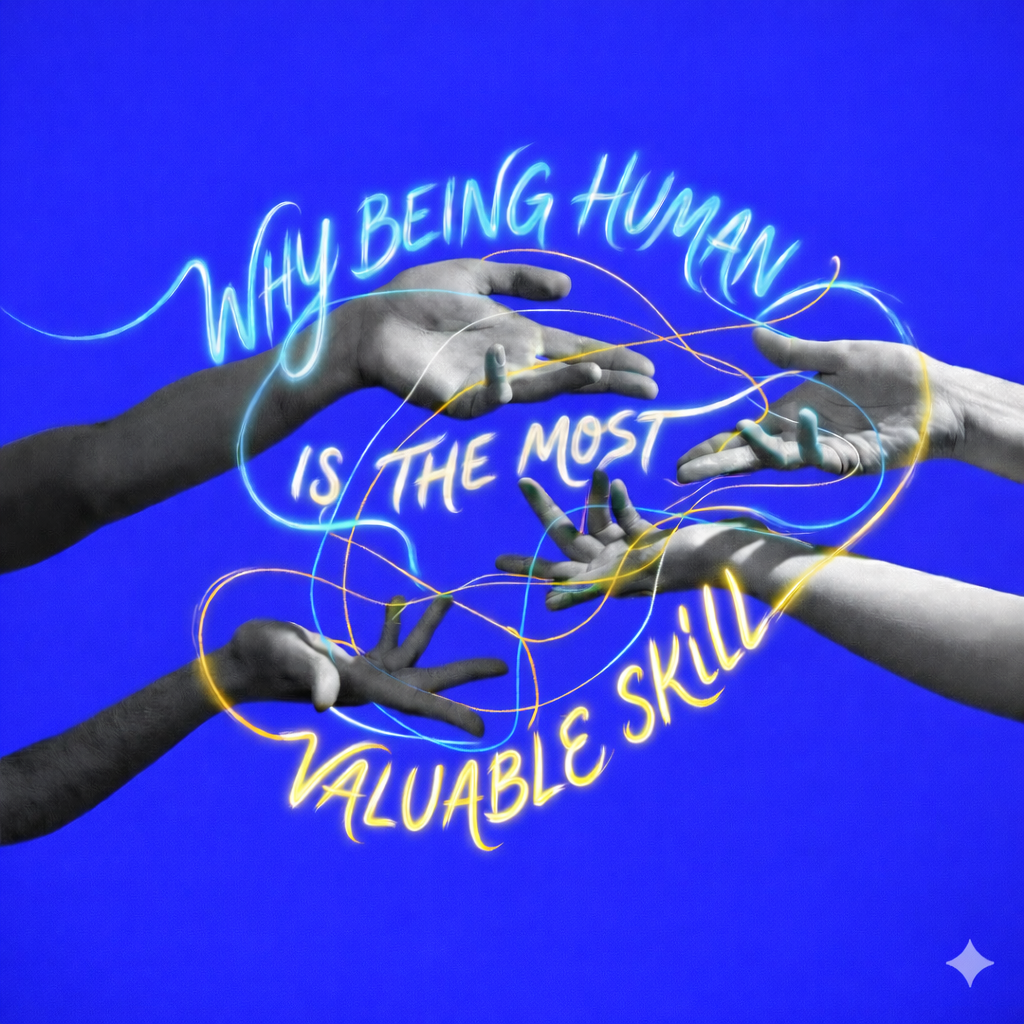
In that sense, the most valuable skill of the coming decade is not intelligence, nor efficiency, nor technical mastery. It is the ability to remain deeply, recognisably human in a world that increasingly is not. And that may be the most profound economic shift of all.