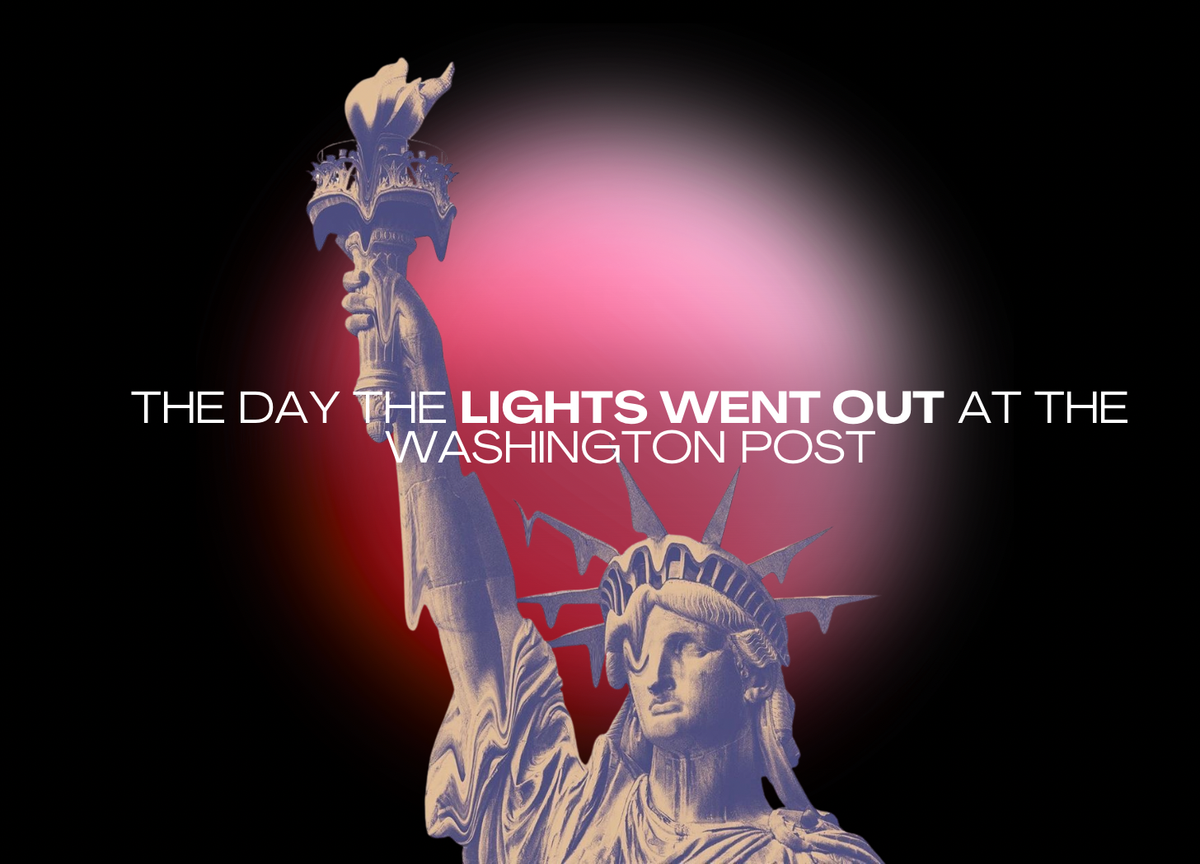
The Day the Lights Went Out at The Washington Post
As mass layoffs gut The Washington Post, the meaning of its famous slogan “Democracy Dies in Darkness” is being tested in real time.
How Jeff Bezos’s Mass Layoffs at The Washington Post Signal a Dangerous Turning Point for Journalism And democracy
On 4 February 2026, The Washington Post — a masthead synonymous with accountability journalism, Pulitzer triumphs, and the phrase “Democracy Dies in Darkness” — announced one of the largest newsroom layoffs in American history. Nearly one-third of its roughly 2,500 employees were cut, including whole sections covering sports, books, world news, and local reportage. Departments once celebrated for unfettered watchdog reporting have been decimated.
This is not a business transition. It is the recalibration of a democratic institution under the direction of its billionaire owner, Jeff Bezos. Far from being incidental, these cuts signal a profound shift in how power, profit, culture, and — crucially — truth interact in the digital age.
A Storied Institution Recast in a Billionaire’s Image
The Post’s tagline, “Democracy Dies in Darkness,” adopted in 2017 to emphasise journalism’s role in holding power to account, now reads like an elegiac irony. For over a century, the paper’s investigative work shaped public understanding of American power — from Watergate to Pentagon leaks and beyond. But the Post’s identity is being remade not on its own newsroom floors but in boardrooms and balance sheets controlled by its owner.
Since purchasing the Post in 2013, Bezos was long seen as a kind of guardian angel for a legacy newsroom struggling in the transition to digital. But over recent years, and particularly since the Post’s controversial decision to withhold an endorsement in the 2024 U.S. presidential election, Bezos’s stewardship has attracted increasing scrutiny. That choice precipitated cancellations from more than 250,000 subscribers, eroding both revenue and trust.
Layoffs of this scale are now altering the newsroom’s DNA. Entire foreign bureaus that formerly chronicled wars, global diplomacy, and human rights have been shuttered. Sports coverage, a cultural touchpoint connecting readers to communities and stories beyond capital politics, has been discarded. Books, local reporting, multimedia teams, and more are reduced or eliminated. This structural shift not only thins reporting capacity; it recasts what the paper believes matters.
The Politics of Scarcity and Silence
Bezos’s tactical silence in the face of staff appeals adds another layer to this story. Weeks before the layoffs were announced, Post employees circulated internal letters urging him to protect key coverage areas. Each was ignored. For many journalists at the Post, that silence was not just managerial; it was emblematic of a shifting institution that once defied power rather than accommodated it.
This pivot is taking place against the backdrop of broader threats to press freedom in the United States. Moments such as the FBI’s raid on the home of a Post journalist last year and arrests of other reporters have rattled journalists and observers alike. Republican leadership’s confrontational posture toward major news outlets has crystallized fears of an era where journalism is not merely criticized, but criminalized.
When the very newsroom once heralded for uncovering corruption shrinks itself in this climate, the impact radiates outward. Fewer boots on the ground mean fewer investigations, fewer cross-examinations of power, fewer stories that ripple across civic consciousness. In effect, self-weakening journalism amplifies the societal darkness it once illuminated.
Democracy in an Era of Scarcity
The stakes of this transformation go far beyond newsroom morale. Independent journalism serves as one of democracy’s most critical feedback mechanisms. It exposes government overreach, corporate malfeasance, misinformation campaigns, and systemic inequities. As newspapers weaken, so does the public’s capacity to make informed choices.
Critics now describe the Post’s latest downturn as a possible “death spiral” — a vicious cycle where diminished coverage results in lost subscribers, prompting further cuts. Even those who frame the layoffs as necessary “strategic realignment” concede that this smaller, narrower newsroom will struggle to deliver the breadth and depth readers historically expected.
When Bezos frames the newspaper as a business first — as his executives have — the implicit message is that journalism’s market value now supersedes its democratic value. In an era where information ecosystems are fractured across social platforms, AI algorithms, and partisan newsfeeds, this trade-off matters. It matters because the loss of local and international reporting creates blind spots that are quickly exploited by bad actors — from authoritarian states to domestic agitators.
The Irony of the Slogan
There was a time when a newspaper’s bold declaration that democracy must be guarded against darkness was aspirational. Today, as that same newspaper contracts under its owner’s hand, the slogan has become both meta and mournful.
Journalist organisations, former editors, and lawmakers have sounded the alarm. Former House Speaker Nancy Pelosi warned that press freedom is “under siege” and linked newsroom contraction to broader democratic erosion.
But warning is not equivalent to remedy.
What Comes Next
The Post’s crisis invites several urgent questions:
- Can independent journalism survive within a corporate model driven by market incentives and owner prerogatives?
- What safeguard exists when media institutions central to democratic accountability are concentrated under billionaire ownership? (Shout this one from the rooftops)
- How can communities reclaim journalistic infrastructure that truly serves the public interest?
More broadly, this is a cultural inflection point. We are witnessing not just layoffs but a reimagining of journalism itself. As legacy outlets recede, alternatives — nonprofit models, community reporting networks, cooperative newsrooms, decentralized media — are emerging. Yet none carry the historical weight or institutional memory of newspapers like the Post.
Recovery, if it comes, will not be a return to the past. It will be a redefinition of public interest journalism — one that must grapple with the reality that mighty institutions can be hollowed from within and that slogans, no matter how noble at inception, cannot protect themselves without a robust civic ecosystem around them.
Closing Thought
In a democracy, information is the oxygen that keeps civic life breathing. The Washington Post built a reputation for surfacing what was hidden, challenging what was comfortable, and illuminating what was contested. Its contraction under Bezos’s ownership is a cautionary tale of how power shapes not only stories but the storytellers themselves.