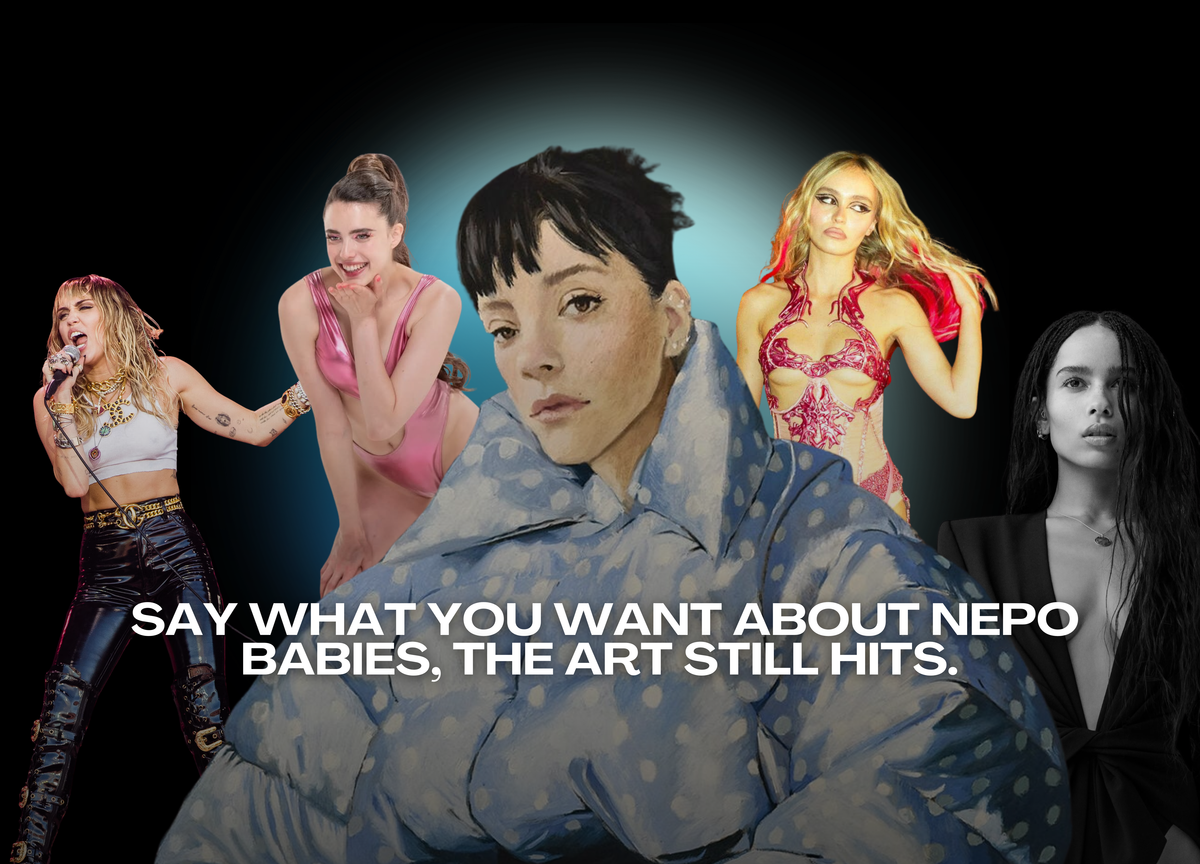
Say What You Want About Nepo Babies, The Art Still Hits.
They were born with access, but they still make art that moves us. From Lily Allen to Zoe Kravitz and Miley Cyrus, Truffle Culture explores the paradox of privilege and pain in pop culture’s most divisive creators.
They were born backstage, not discovered there. While others fought to be noticed, they arrived with names that already shimmered under the lights. And yet, sometimes what they bring through those gilded doors isn’t arrogance or gloss—it’s something harder to look away from. It’s pain. It’s truth. It’s art that shouldn’t move us, but does anyway.
Lily Allen’s West End Girl (2025) is that contradiction: a record that sounds like a wound turned melody. Her voice, raspy and human again, narrates a divorce and the unravelling of a public marriage with an intimacy that feels indecent to witness. The production is skeletal; the humour, dry and self-aware. You can almost hear her shrug at her own privilege as she sings about loneliness. The daughter of actor Keith Allen, Lily grew up in British pop’s backstage chaos—always both insider and underdog. On West End Girl, that duality finally collides. This isn’t reinvention. It’s reckoning.
Online, “nepo baby” has become an insult: shorthand for everything wrong with art in an age obsessed with access. It flattens nuance, treating opportunity as theft and lineage as sin. But what happens when one of these supposedly unearned voices delivers something honest—something that hits all the way down? Does our resentment collapse, or deepen? Are we angry at their access, or afraid that access didn’t kill their sensitivity?
Allen isn’t alone in forcing that question.

Margaret Qualley, daughter of Andie MacDowell, didn’t just act in Maid—she inhabited it. The series was bruised realism: a study of exhaustion and survival. She didn’t perform poverty porn; she embodied its dignity. Her work feels like inheritance transmuted—proof that emotional labour can’t be passed down, only learned.
Miley Cyrus turned pop catharsis into reclamation. Endless Summer Vacation was both anthem and admission, the sound of a woman picking herself up while still bleeding glitter. The daughter of Billy Ray Cyrus, she has spent her adult life dismantling the narrative that built her. Watching her evolve from Disney export to cultural truth-teller feels like witnessing a phoenix realise she was set on fire by her own PR team.
Zoe Kravitz operates on a quieter frequency. Everything she touches hums with detachment and poise—fashion campaigns, High Fidelity, even her music. There’s a deliberate coolness mistaken for emptiness, but it’s actually armour. Raised in the spotlight, Kravitz learned how not to burn. If Allen’s art bleeds, Kravitz’s art bruises—quietly, beautifully.
Hannah Einbinder, daughter of SNL’s Laraine Newman, rewired the nepo narrative through comedy. In Hacks, her character’s insecurity and defiance feel too precise to be fiction. Einbinder turns inherited timing into critique—she uses humour the way Allen uses heartbreak: as proof that pain doesn’t respect pedigree.
And Lily-Rose Depp—perhaps the most vilified of the bunch—became 2025’s cultural scapegoat. Her turn in The Idol was messy, provocative, undeniably magnetic. Even when the show faltered, she emerged as something real: a performer aware of her privilege yet unafraid to explore its moral rot. If the project was a disaster, she was its poetry.

What binds these women isn’t just lineage—it’s defiance. Every success is questioned, every failure celebrated. The internet waits for them to bleed. And when they finally do, we accuse them of performance. It’s an impossible calculus: we demand authenticity from those we’ve already decided are fake.
But that’s the quiet power of this new wave of nepo art. It doesn’t beg for credibility; it sits in discomfort. It knows the camera was already rolling when they were born. Their work becomes a commentary on that surveillance—the way access distorts, exposes, and sometimes inspires. These artists create like they’re trying to earn a room they were born into. The result is work laced with guilt, precision, and beauty.
The resentment toward privilege is justified—systems are unequal. Yet art isn’t a courtroom, and feeling isn’t democratic. If the work hits you in the gut, it’s real in that moment, no matter who paid for the microphone. Lily Allen’s divorce ballads don’t lose their heartbreak because she once had a trust fund. Qualley’s weary eyes don’t lose their weight because her mother was famous first. Miley’s roar doesn’t quiet because she grew up on a tour bus.
Maybe that’s the lesson hiding inside the discourse: pain, when translated honestly, disregards class. Privilege might buy a studio, but it can’t fake ache. And somewhere beneath our outrage, we recognise ourselves in these flawed heirs trying to earn sincerity in public. Their guilt is the price of our entertainment; their art, our uneasy empathy.
Because sometimes, the song is just good. The performance hits. The line lands. The blood is still red, even if the carpet beneath it was rolled out long before they arrived.