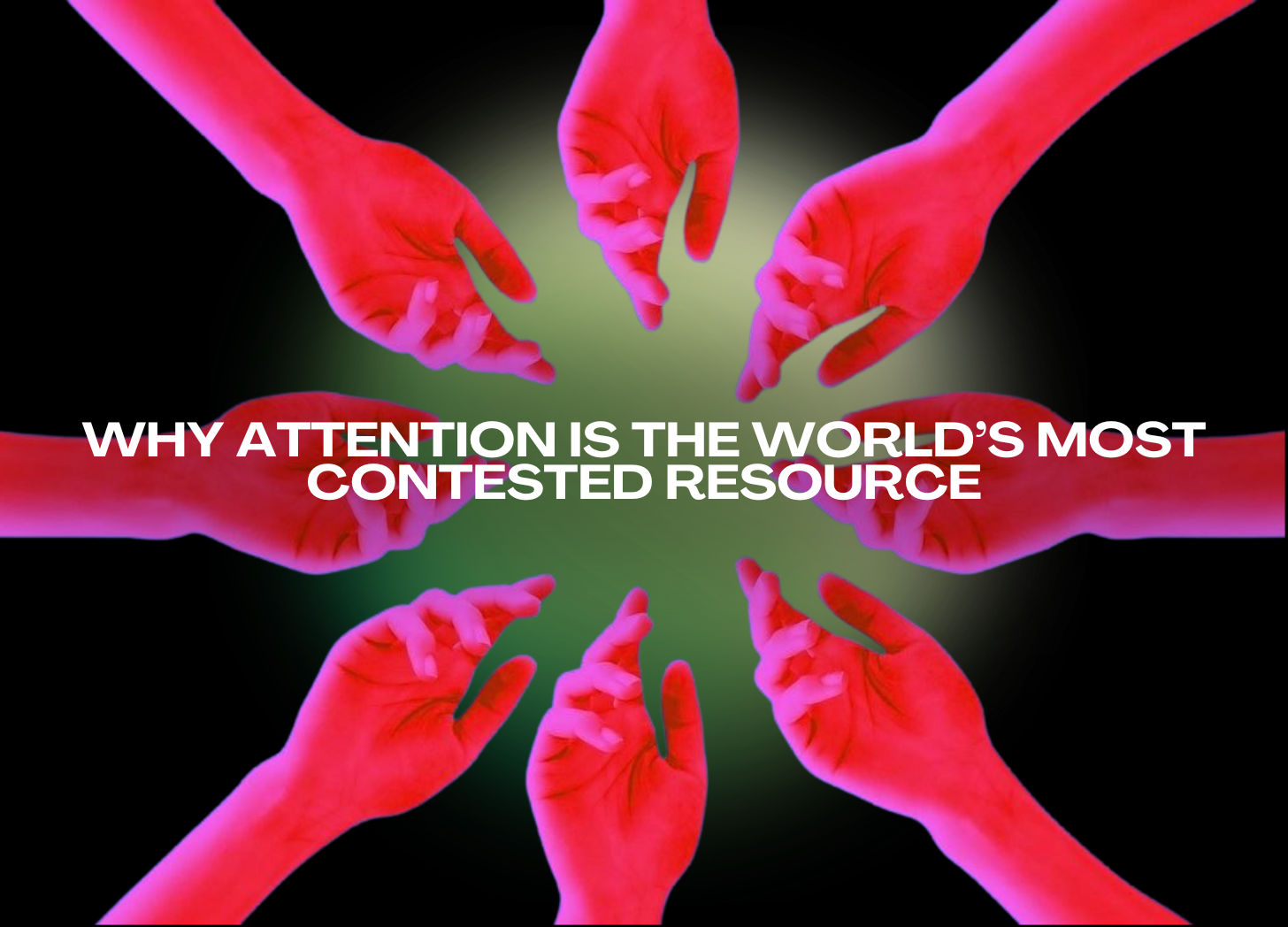
Why Attention Is the World’s Most Contested Resource
Power has shifted from land and labor to the mastery of human focus. In an age of AI-driven content hyper-inflation, attention is the ultimate cognitive currency. For Truffle Culture, the next decade is defined by a shift from extraction to stewardship—where trust, not volume, is the advantage.
The Great Attention Reset: How Resource Scarcity is Redefining Power, Culture, and Brand Value
There was a time when power was a matter of geography and physical muscle—concentrated around land, labor, and capital. Today, the global power structure has shifted toward something far more fragile, invisible, and finite.
Attention.
At Truffle Culture, we don't view "attention as currency" as a mere marketing metaphor. It is a rigorous cultural signal grounded in economics, media theory, and cognitive science. The research is definitive: in an information-saturated world, human focus has become the scarcest resource in the system.
To navigate the modern landscape, we must understand the intellectual foundations of this shift. Here is the data behind the world’s most contested resource.
1. The Historic Shift: From Information Scarcity to Cognitive Poverty
For most of human history, information was the luxury good. To possess a book in the 14th century was to hold a concentrated piece of the world’s wealth. The Gutenberg press began the democratisation of data, but even through the mid-20th century, the "bottleneck" remained the distribution of information.
The paradigm cracked in 1971. Nobel laureate Herbert A. Simon issued a warning that now reads like prophecy: “A wealth of information creates a poverty of attention.”
Simon’s insight was structural. He argued that in an information-rich world, the "wealth" of data necessarily consumes the "attention" of its recipients. Therefore, a wealth of information causes a dearth of attention and a need to allocate that attention efficiently among the overabundance of information sources that might consume it.
By the late 1990s, this academic observation transitioned into a cultural diagnosis. In 1997, Michael Goldhaber famously wrote in Wired that attention, not information, was the “natural economy of cyberspace.” Information was becoming infinite and free; therefore, it could no longer be the primary driver of value. Attention—the one thing that cannot be manufactured or replicated—became the new gold standard.
2. The Current Context: The Era of Synthetic Abundance
Fast forward to 2026, and we are no longer just dealing with "information." We are dealing with Synthetic Abundance.
The explosion of generative AI has created a "content hyper-inflation." When machines can generate professional-grade video, text, and music in seconds, the cost of content production drops to zero. As a result, the volume of noise has reached a terminal velocity.
The Valuation of the "Eye-Share"
If theory needed validation, current industry data provides it. The PwC Global Entertainment & Media Outlook (2025–2029) forecasts that advertising revenue—the direct monetization of attention—will exceed consumer spending by roughly $300 billion in the coming years.
Advertising is no longer a "support" for media; it is the dominant engine of global growth. However, a critical shift is occurring: Not all attention is equal. Research from McKinsey & Company suggests that roughly one-third of revenue variance in media is now driven by the “quality of attention.” Depth of engagement, "dwell time," and active focus are becoming more predictive metrics than raw, fleeting impressions.
3. The Cognitive Cost: Mining the Human Mind
Attention is not an infinite extractive resource. Dr. Gloria Mark, a leading psychologist in human-computer interaction, has documented a staggering decline in sustained focus. Her research suggests that average uninterrupted attention on screens has plummeted from two and a half minutes in 2004 to under 50 seconds today.
This constant state of "cognitive dilution" has measurable physiological costs:
• The Switch-Cost Effect: It can take over 20 minutes to regain full cognitive flow after a single notification interruption.
• The Dopamine Debt: Algorithms are designed to exploit our biological "orienting reflex," keeping us in a state of perpetual arousal that leads to systemic burnout.
When corporations mine attention as if it were oil, they create "digital pollution"—a landscape of fragmented thoughts and exhausted users.
4. Predictions: The Next Decade of the Attention Currency (2026–2036)
As we look toward the next ten years, Truffle Culture envisions a radical "Attention Great Reset." The next decade will not be defined by who shouts the loudest, but by who manages attention with the greatest integrity.
I. The Rise of the "Focus Premium"
We predict a bifurcation of the digital world. The "Public Feed" will become increasingly seen as a low-value, high-noise environment—the "fast food" of information. In contrast, we will see the rise of Premium Focus Environments: closed networks, paid communities, and high-quality long-form platforms where the currency is "Depth" rather than "Clicks." Access to quiet, uninterrupted digital spaces will become a luxury status symbol.
II. Attention Regulation and Sovereignty
By the late 2020s, we anticipate the arrival of "Cognitive Rights" legislation. Just as GDPR regulated data privacy, new frameworks (already being hinted at in the EU AI Act 2026) will target "manipulative design." Companies will be held accountable for "attention theft"—dark patterns designed to keep users scrolling against their will. We will see the rise of "Attention Dashboards" as a standard feature, tracking not just screen time, but the quality of cognitive recovery.
III. The "Interpreter" Economy
In an era where AI can generate anything, the value of the "Generator" will crash. The new power players will be the "Interpreters"—the curators, the thinkers, and the brands that act as a signal-to-noise filter. Influential voices will no longer be those with the most followers, but those with the highest "Trust-to-Time" ratio.
IV. Algorithmic Transparency as Brand Equity
Over the next decade, brands that "black box" their engagement tactics will lose market share. Consumers will demand to know how they are being targeted. We envision a future where "Organic Attention" (attention given voluntarily without manipulative nudges) becomes a primary KPI for CMOs, replacing the increasingly hollow metric of impressions.
5. What This Means for Cultural Foresight
If attention is the new currency, we are currently living through a resource war fought over human consciousness. The most powerful institutions are no longer those with the largest physical footprint, but those with the most sophisticated distribution and recommendation algorithms.
However, the tide is turning. We are moving from an era of Attention Extraction to an era of Attention Stewardship.
The next competitive edge won't belong to the loudest voice in the room, but to the trusted presence that respects the human cognitive limit. In an age of noise, the ultimate luxury—and the ultimate strategy—is narrative coherence and the ability to hold focus without exhausting it.
References
• Simon, H. A. (1971). Designing Organizations for an Information-Rich World. Maryland: Johns Hopkins University Press.
• Goldhaber, M. (1997). “The Attention Economy.” Wired.
• Davenport, T. H., & Beck, J. C. (2001). The Attention Economy: Understanding the New Currency of Business. Harvard Business School Press.
• Jhally, S., & Livant, B. (1986). Watching as Working: The Valorization of Audience Consciousness.
• PwC (2025–2029). Global Entertainment & Media Outlook.
• McKinsey & Company (2023). The Attention Equation: Winning the Right Battles for Consumer Attention.
• Mark, G. (2023). Attention Span: A Groundbreaking Way to Restore Balance, Happiness and Productivity.
• Eppler, M. J., & Mengis, J. (2004). The Concept of Information Overload: A Review of Literature.
• Stanford HAI (2026). AI Experts Predict: Rigor, Transparency, and the Focus on Utility.
• World Economic Forum (2026). The Future of Money and the Digital Shift.